Outsource Quality Assurance Services: A Buyer's Guide
Learn how outsource quality assurance services work, which delivery model fits, and how to assess providers and verify testing evidence before release.
In this article
- What Outsourced QA Services Actually Deliver
- Keep a release owner inside your team
- Delivery Models Compared at a Glance
- Match the model to the bottleneck
- Compare the work behind the price
- Where Outsourcing Fits and Where It Does Not
- Separate compatibility checks from specialist assessments
- Validating AI-Generated Test Cases First
- Check relevance, observability, and coverage
- Leave room for human investigation
- How an Outsourced QA Engagement Runs, Step by Step
- Prepare the job
- Execute, verify, and rerun
- How to Assess a Provider and Its Contract
- Read what the terms actually transfer
- Check whether judgments are auditable
- Evidence That Makes a QA Result Decision-Ready
- Read the execution record
- Run a Paid Pilot Before Committing
- Set acceptance criteria before execution
- Decide what earns expansion
Software defects cost the U.S. economy an estimated $59.5 billion annually in a 2002 NIST-commissioned study, which also estimated that improved testing infrastructure could potentially eliminate about $22.2 billion of those losses, according to the summary of NIST's findings. That's a historical U.S. estimate, not a current market valuation. Its practical lesson still matters: testing earns its place by finding problems while the team can act on them.
When you outsource quality assurance services, you're buying evidence about a release, not just access to more testers. The important questions are what they'll check, whether those checks address actual product risks, and what proof you'll receive afterward.
What Outsourced QA Services Actually Deliver
In 2025, 76% of surveyed QA professionals reported using AI-powered tools in software testing, while 56% said their teams still struggled to keep up with testing demands, according to Katalon's State of Software Quality Report. More tooling doesn't automatically remove an execution backlog. Someone still needs to prepare accounts, run workflows, investigate failures, and explain what remains uncertain.
Say your team has finished a checkout redesign. Developers have tested individual components, but nobody has completed the payment flow on the requested phones and browsers. An external provider can run your cases, explore around them, capture failures, and return a coverage report while your engineers address release-blocking defects.
The arrangement is like hiring a building inspector rather than another construction crew. The inspector brings equipment and checks the work against an agreed standard. They don't decide what the building is for, and their inspection doesn't transfer the owner's responsibilities.
Keep a release owner inside your team
For an execution-focused engagement, your responsibilities include:
- Test strategy and priorities: Identify which failures would prevent release and which risks you'll accept.
- Usable access: Supply the correct build, working credentials, permissions, and test data.
- Product decisions: Resolve ambiguous requirements and explain intended behavior.
- Release approval: Make the final go or no-go decision using the findings and remaining gaps.
The provider's work should end with something your team can use, not a folder of screenshots. Developers need actionable defects; the release manager needs a clear account of completed and incomplete testing.
Buying rule: Outsourced QA adds execution capacity and independent eyes. It doesn't remove accountability for release quality.
A broader managed service can take responsibility for planning too, but that responsibility needs an explicit scope and acceptance criteria.
Delivery Models Compared at a Glance
The delivery models differ in who directs the work, how you pay, and which responsibilities the provider accepts.
| Model | Who runs the tests | How it is billed | Best fit | Main risk |
|---|---|---|---|---|
| Project-based testing | Vendor team working against a fixed scope | Fixed fee per project | One-off major release or migration | Scope drift when requirements change mid-project |
| Crowdsourced execution | Independent testers using their own devices | Per session or package | Device and browser gaps, real-hardware checks | Quality relies on briefing and independent verification |
| Dedicated outsourced team | Vendor-employed QA engineers inside your sprints | Monthly rate per engineer or team | Ongoing regression and sprint testing | Undocumented product knowledge stays with the vendor |
| Managed QA service | Vendor owns agreed strategy, execution, and reporting | Monthly retainer tied to service levels | Teams without in-house QA leadership | Report depth can be difficult to audit |
| Staff augmentation | Individual QA engineers under your management | Hourly or monthly rate per engineer | Filling a specific skill gap | You still manage the work and outcomes |
| Test automation outsourcing | Vendor builds and maintains automated scripts | Project fee plus ongoing maintenance | Stable regression on a long-lived product | Interface changes create script upkeep |
Match the model to the bottleneck
A migration with a stable acceptance checklist suits project-based testing. You can define the deliverable, agree on exclusions, and close the engagement when the migration checks are accepted.
A fintech app approaching release with gaps across Android manufacturers points toward crowdsourced execution. The missing resource is compatible equipment and people who can use it, not necessarily another permanent engineer.
For recurring sprint regression, a dedicated team can retain knowledge of permissions, account states, and unusual workflows. Require shared documentation so that knowledge remains usable when individuals leave.
A team without a QA lead may need a managed service, but it must retain someone capable of challenging priorities and accepting deliverables. Otherwise, the vendor effectively evaluates its own strategy.
Staff augmentation suits a team that already knows how to manage testing but lacks a particular skill, such as Appium experience. Automation outsourcing suits repeatable workflows when the contract includes failure investigation and script maintenance, not just initial delivery.
Compare the work behind the price
A session price means little until you've fixed the device matrix, case allocation, setup requirements, and evidence standard. A session spent creating accounts isn't equivalent to one spent executing prepared cases.
You can combine models: retain a dedicated regression team and add crowdsourced physical-device checks before a major launch. Keep their scopes distinct so neither assumes the other covered an important workflow.
Where Outsourcing Fits and Where It Does Not
Outsourced execution works best when the bottleneck is hardware, people, or available time. It's a weaker answer when you need unresolved product decisions, code-level investigation, or a specialist assessment.
In 2024, 86% of respondents said testing was important to the quality and success of their organization's mobile-app development, while only 27% said their current strategy exceeded expectations, according to Tricentis. Recognizing testing's importance isn't the same as selecting an appropriate delivery model.
| Situation | Outsourcing fit | Why | Better option |
|---|---|---|---|
| Many Android models from different manufacturers | Strong fit | Real phones expose hardware and OS behavior emulators can miss | Keep an in-house device set for daily smoke tests |
| Fixed release deadline with a testing backlog | Strong fit | Adds temporary execution capacity | Book capacity before code freeze |
| Budget Android phones on local mobile networks | Strong fit | Testers use relevant equipment and networks | Add controlled network-throttling checks internally |
| Writing test cases from scratch | Partial fit | Execution services may exclude test design | Own design or commission it separately |
| Building or maintaining an automation framework | Poor fit for manual execution | Requires engineering ownership and upkeep | Hire or contract automation engineers |
| Security or penetration testing | Poor fit for general execution | Needs specialist tooling and authorization | Commission a security testing firm |
| Performance or load testing | Poor fit for manual execution | Requires load profiles and server instrumentation | Use a performance-testing specialist |
| Certification or audit under a named standard | Poor fit | Human execution isn't certification | Use an appropriately accredited auditor |
| Native desktop application testing | Poor fit for mobile and browser crowd models | Requires a desktop-specific scope | Use internal or specialist desktop QA |
Separate compatibility checks from specialist assessments
Say a retail app needs checks across a broad Android range, but the internal lab holds only the team's primary development phones. External testers can extend that range without requiring the team to purchase and maintain every target.
Physical devices matter for camera permissions, biometric prompts, memory pressure, manufacturer customizations, and mobile-network transitions. An emulator remains useful for repeatable development checks, but it doesn't establish how the app behaves on the requested handset. Use a real-device app testing plan to specify the equipment and conditions that matter.
The table's poor-fit ratings apply to general manual execution, not every outsourced QA company. Specialist providers can take on automation, security, or performance work under separate engagements.
Our scope at 99tests excludes test automation, security or penetration testing, certification or audit under any standard, performance or load testing, native desktop apps, and writing your test cases. Those exclusions help you route work correctly rather than mistake a functional test report for an assessment it was never designed to provide.
Validating AI-Generated Test Cases First
Executing more cases doesn't necessarily produce better coverage. A provider can complete a large inventory accurately and still miss the release risks because the inventory itself is weak.
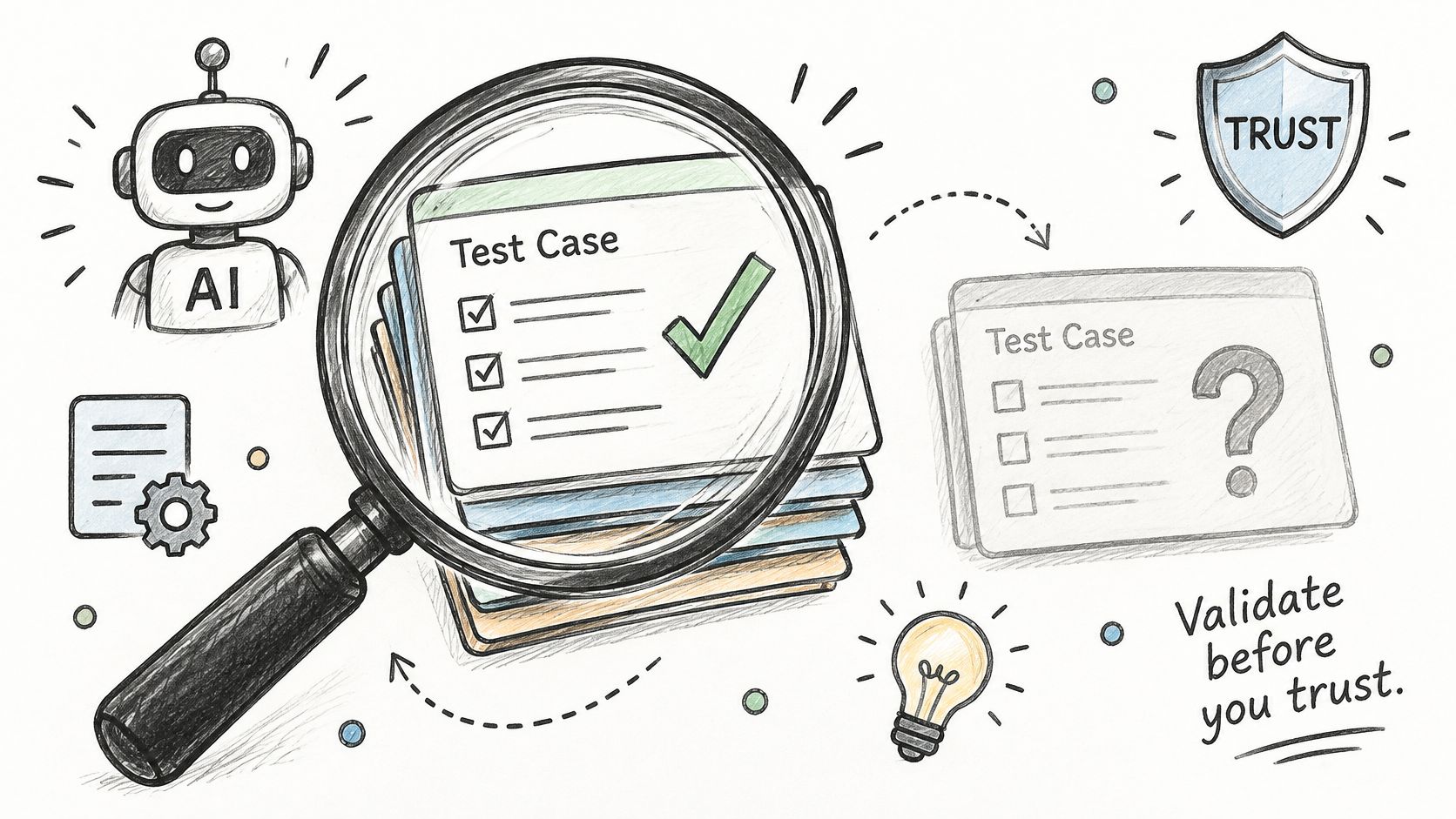
Test-case generation is the leading AI testing use case at 70%, while 92% of organizations struggle to keep requirements current, according to Applause's State of Digital Quality functional-testing findings. That combination makes review essential: generated cases can reflect an outdated specification with convincing precision.
Treat the generated inventory as a draft requiring inspection.
Check relevance, observability, and coverage
Start with a hypothetical login suite containing repeated successful-login cases and checks for a password rule the product no longer uses. Sending everything for execution creates work without improving confidence.
Review it in this order:
- Check against the current build. Remove references to absent features, retired rules, and inaccessible account states. Resolve disagreements with the product owner before assigning execution.
- Make each result observable. Replace instructions such as “verify login works correctly” with actions and expected outcomes. State what happens to the session, navigation, error message, and account state.
- Map cases to risks and environments. Identify the relevant device, browser, operating system, persona, and failure risk. Merge equivalent cases, but retain differences that exercise meaningfully different behavior.
Use a review process for AI-generated test cases before purchasing execution capacity. A reviewer should be able to explain what each retained case adds.
Leave room for human investigation
An exact script won't necessarily reveal confusing recovery instructions, inaccessible focus order, or a workflow that fails only after an unexpected interruption. Give testers a defined exploratory charter around high-risk flows, rather than assuming generated steps exhaust the possibilities.
For an AI feature, distinguish functional checks from judgments about response quality and adversarial behavior. A successful request and response doesn't establish that the answer is useful or safe.
Case existence is not risk coverage. Approve the mapped plan, not the size of the uploaded file.
We parse uploaded cases into a plan and show coverage before testers start. Use that view to correct missing targets and misplaced assumptions while changes are still cheap.
How an Outsourced QA Engagement Runs, Step by Step
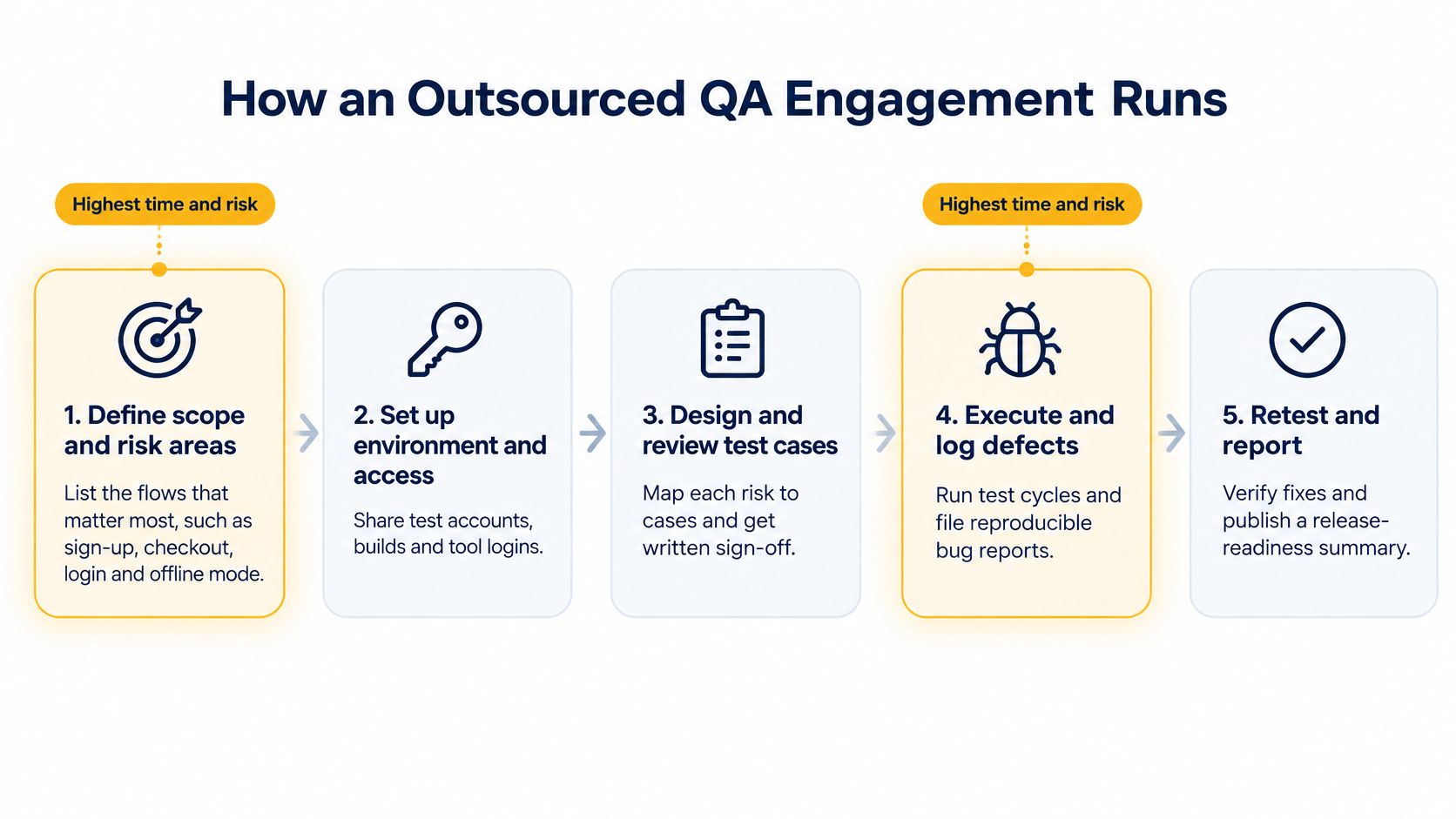
The handoff should make dependencies visible before execution begins. Account preparation, build distribution, and device matching deserve the same attention as the test cases.
Use the process flow to identify where preparation ends and evidence collection begins.
Prepare the job
Define scope and risk areas. List the flows that matter, such as sign-up, checkout, login, and offline behavior. State exclusions and identify the person authorized to answer requirement questions.
Share a usable build and access. Supply an APK link, Google Play internal testing invitation, TestFlight access, or web URL with working credentials. Test the invitation yourself from an account outside your organization so access problems don't consume execution time.
Submit and review the cases. Provide the cases in a usable format and inspect the resulting coverage plan. A written test-plan example can help you distinguish scope, prerequisites, expected results, and completion conditions.
Set environment targets. Name device brands, minimum operating systems, and browser versions. Separate mandatory matches from acceptable substitutions so the provider doesn't improvise compatibility coverage.
After payment, our submission process takes the build or web link, cases in any format, targets, and deadline; testers start within the hour. Prepare those inputs before paying rather than treating the start window as time for internal coordination.
Execute, verify, and rerun
Run the assigned work. Testers execute cases manually on their own equipment, record outcomes, and file defects with environment details and supporting media. Keep a contact available to resolve blockers without changing expected behavior informally.
Verify findings independently. Verification should check completeness, merge duplicates, and grade severity against written definitions. Separate an observed failure from an assumption about its technical cause.
Review incomplete work. Inspect passed, failed, blocked, and unrun cases. Decide whether an access fix, replacement target, or additional execution is needed before accepting the delivery.
Retest the next build. Rerun the relevant plan to confirm fixes and check adjacent behavior. Preserve build identifiers so the team doesn't confuse an old failure with a current result.
Device matching can interrupt this sequence. If we can't find a match within the turnaround, we widen the search once; still-unfilled sessions become credits sent to the customer's email for the next job.
Use the accompanying video alongside the written workflow.
How to Assess a Provider and Its Contract
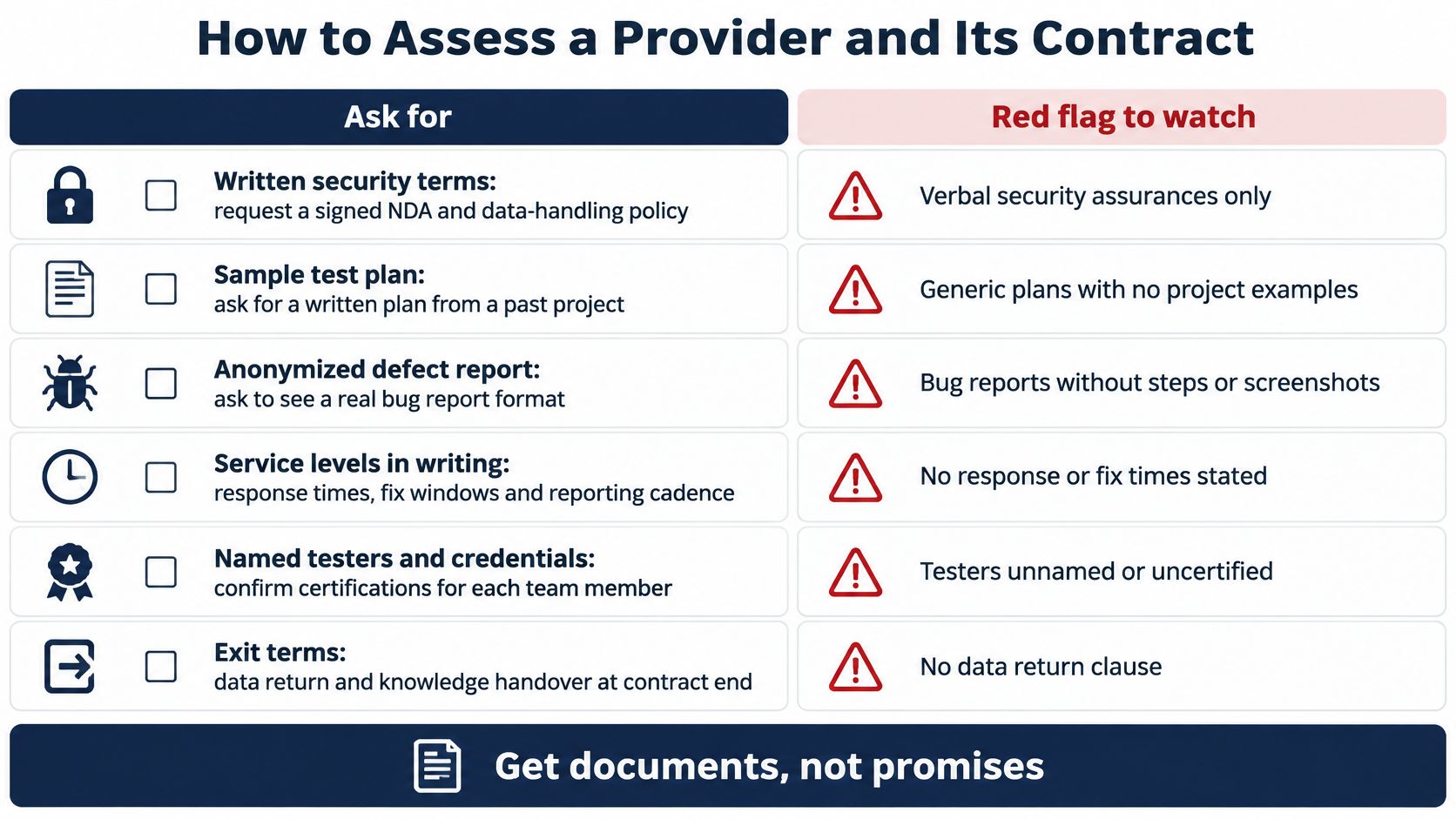
Request documents, not verbal assurance. A provider's response should let you trace a promise to an operating procedure, report field, or contractual remedy.
Send the same request list to each candidate. For the broader relationship, MR2 Solutions vendor management guidance provides a useful companion to the testing-specific checks: assign ownership for reviewing obligations rather than leaving the contract untouched after signing.
| Criterion | What to ask for in writing | Red flag |
|---|---|---|
| Tester sourcing | Pool size, vetting process, and owned-device inventory | Global-network claims without a relevant device list |
| Verification | Who grades defects and whether finders can grade their own | The same person finds and grades each defect |
| Severity rubric | Grading definitions and appeal or review path | Severity assigned without a reference |
| Data handling | Access limits, build-sharing rules, and deletion arrangements | Builds retained indefinitely or shared beyond assigned testers |
| Confidentiality | Tester agreements accepted before access | Informal access without confidentiality terms |
| Liability | Responsibilities, exclusions, and delivery commitments | Blanket disclaimers without delivery obligations |
| Pricing | Fixed fee or rate, overage rules, and scope-change handling | Uncapped hourly billing |
| Missed deadlines | Remedy recorded in the invoice or order | No stated remedy for late reports |
The checklist below is useful for gathering the supporting artifacts. Treat credentials as relevant to the work: specialist qualifications matter where required, but a certificate alone doesn't demonstrate effective functional testing.
Read what the terms actually transfer
At 99tests, testers are independent contractors bound by confidentiality, and we aren't liable for defects the testing didn't surface. You're purchasing a defined testing effort and its deliverables, not a guarantee that the software contains no undiscovered defects.
That distinction matters when negotiating acceptance. Tie acceptance to the agreed scope, evidence quality, and delivery conditions rather than an impossible promise of defect-free software.
Our testers accept confidentiality terms before taking sessions. Builds are shared by link only with assigned testers, and we don't store builds beyond the job. Keep those rules in your procurement record and ensure your own distribution links don't grant broader access than intended.
Access governance also requires action from your team:
- Use dedicated test accounts: Avoid personal employee credentials and unrestricted administrator access.
- Prepare suitable test data: Don't expose production customer information to make a scenario easier to reproduce.
- Plan revocation: Assign someone to disable accounts and invitations when the engagement ends.
- Define escalation: Name the contact for an accidental disclosure or suspicious access event.
Check whether judgments are auditable
Our verification is separate from execution: the person who finds a bug never grades it. That separation reduces the conflict involved when a finder's reward and severity judgment could otherwise align.
A useful sample report shows how the reviewer reached the conclusion, not just the conclusion itself.
Request an anonymized completed report. Trace a finding from its reproduction steps through duplicate handling and severity rationale, then check whether the contract identifies a review path for disputed grading. A polished summary isn't enough if the underlying decisions can't be inspected.
Evidence That Makes a QA Result Decision-Ready
Consider a hypothetical report with 180 planned case executions, of which 96 passed, four failed, and 80 were blocked or unrun. Only 100 of 180, approximately 56%, reached an executed result. The failures matter, but the incomplete coverage may create greater release uncertainty.
Reproducibility deserves equal attention: 84% of surveyed organizations struggled to reproduce defects with available test data, while only 33% reported maintaining thorough test documentation, according to DevOps Digest's State of Digital Quality coverage.
| Evidence item | What it proves | Weak version |
|---|---|---|
| Device and operating system | Exact hardware and OS used | Android tested |
| Browser and version | Compatibility with the specified browser | Chrome |
| Build identifier and test-case version | Results correspond to the intended release | Latest build |
| Timestamps and session log | Who ran assigned cases, when, and for how long | Undated summary |
| Screenshots or recordings | Observable evidence supporting reproduction steps | Text-only defect titles |
| Expected versus actual behavior | A defined discrepancy | App sometimes crashes |
| Severity rationale | Why the impact warrants its grade | Unexplained severity label |
| Duplicate handling | Repeated findings were consolidated | Raw submission count |
| Blocked and unrun cases with reasons | The coverage denominator is complete | Only passes and failures |
Read the execution record
Check network context, reproduction steps, and account prerequisites alongside the table. Media supports a report, but it doesn't replace instructions another engineer can follow.
Our session log shows start and end times, tester band, cases assigned, and cases completed for every session that ran. Compare the claimed work with the recorded duration, including setup and evidence capture.
Reports arrive as a hosted page and PDF, addressed to the payer and forwardable to the people who need to act. Session recordings remain private and are linked only from the customer's report.
Decision-ready means every planned case has a final status and every incomplete case has a reason. Without that, the release manager can't distinguish an acceptable exclusion from an unnoticed gap.
Run a Paid Pilot Before Committing
I wouldn't sign a long-term agreement before running a paid pilot on an upcoming release. Use a contained scope with enough complexity to test the provider's judgment, not just its ability to follow a happy path.
Set acceptance criteria before execution
Choose a build, a defined device and browser list, and high-risk flows such as sign-up, payment, and offline recovery. Include the account states and prerequisites needed to run them.
Then agree on the evidence you'll use to accept the pilot:
- Status completeness: Every planned case must receive a final disposition.
- Reproducibility: Your engineers should be able to follow the delivered defect instructions.
- Delivery timing: Compare receipt of the report with the agreed deadline.
- Blocker explanations: Require a specific reason and affected scope for incomplete execution.
Size the pilot using the target matrix and expected work, not the cheapest package label. Our fixed-price packages are Starter at ₹9,999 plus GST, Standard at ₹18,999 plus GST, and Deep at ₹34,999 plus GST.
Decide what earns expansion
We use fixed pricing with no hourly overages, expenses, or change requests. A slot can be a phone, laptop, or browser, and you can mix them within a job; establish the intended mix before submitting.
If we miss the report deadline shown on the invoice, we commit to make it right, except when the build or test credentials weren't available to our testers. Keep that dependency visible in your pilot record.
If the provider meets the acceptance criteria, expand into the delivery model that matches your ongoing bottleneck. If blocked or unrun cases remain unexplained, reject the engagement rather than buying more capacity to compensate for weak reporting.
99tests offers crowdsourced manual execution of your test cases on real devices, with independently verified findings and documented coverage gaps. Visit 99tests to select a paid pilot, prepare your build and target list, and evaluate the evidence before committing to a broader testing arrangement.