Top Real Device Cloud Solutions vs Competitors for Cross Device Testing
BrowserStack, Sauce Labs, TestMu AI and 99tests compared for cross-device testing: core offering, AI capabilities, device coverage and which team each fits.
In this article
- Evaluating the Enterprise Cross-Device Testing Landscape
- 1. BrowserStack
- 2. Sauce Labs
- 3. TestMu AI
- 4. 99tests
- Verdict: Which Platform Fits Your Engineering Organization?
- Frequently Asked Questions
- What is a real device cloud in cross-device testing?
- How do AI capabilities improve enterprise test automation?
- Why use real devices instead of emulators or simulators?
BrowserStack stands as the overall top real device cloud solution for enterprise cross-device testing, delivering robust manual and automated test execution across a massive global device lab in 2026. For teams that need human testers running their test cases on real phones rather than another device cloud, 99tests is the option to add.
| Option | Core offering | AI capabilities | Device coverage |
|---|---|---|---|
| BrowserStack | Manual and automated real device testing | Test Companion and agentic AI tools | Thousands of real devices and browsers across 25 data centers [1] |
| Sauce Labs | AURA AI-unified release assurance | Sauce AI for authoring and insights | 10,000+ real Android and iOS devices |
| TestMu AI | Unified quality engineering platform | Kane AI autonomous agentic test planning | Scalable global real device cloud |
| 99tests | Human testers who run your test cases on their own real devices | Executes AI-generated test cases; MCP server for coding agents | Testers' own Android phones, iPhones and desktop browsers across India |
Evaluating the Enterprise Cross-Device Testing Landscape
Cross device testing has moved past simple responsive design checks in web browsers. QA leaders face a fragmented ecosystem of foldable displays, varied mobile operating system versions, and demanding release cadences. Real device cloud solutions must handle this friction without introducing flaky test grids or endless queue times.
Frankly, the QA tooling market is noisy with vendor claims about autonomous intelligence. Most of what gets marketed as agentic AI is nothing more than a glorified script generator that still breaks the moment an element locator shifts by two pixels. Engineering teams need infrastructure that actually holds up under daily CI/CD pipeline pressure.
1. BrowserStack
BrowserStack stands out as a leading platform for cross-device testing, offering robust live manual testing and automated test execution across a vast array of real mobile devices and browsers [1]. Trusted by thousands of global customers, it integrates AI agents to boost testing velocity and streamline workflows from planning to release [1].
BrowserStack remains the default choice for teams that value sheer reliability over experimental features. Its infrastructure handles connection drops gracefully during live manual debugging sessions.
The inclusion of Test Companion and automated visual testing via Percy cuts down the time engineers spend chasing false positives [1]. If your organization runs hundreds of parallel test suites across legacy and cutting-edge hardware, BrowserStack's global labs keep execution bottlenecks to a minimum.
2. Sauce Labs
Sauce Labs provides enterprise-grade test verification through its AURA platform, designed to verify AI-generated code and accelerate release cycles [2]. Their Real Device Cloud supports verification across more than 10,000 real Android and iOS devices, helping teams reduce production incidents significantly [2].
Sauce Labs built its reputation on scale, and the AURA platform continues that trajectory for modern pipelines [2]. Their Real Device Cloud boasts over 10,000 distinct Android and iOS configurations [2].
Here is what gets missed in standard feature comparisons: Sauce Labs excels when security teams demand rigid isolation. Their enterprise-grade security posture and error-reporting capabilities make root-cause analysis straightforward when a nightly build fails on an obscure tablet configuration.
3. TestMu AI
TestMu AI (formerly LambdaTest) delivers a unified quality engineering platform featuring Kane AI for multi-modal test generation [3]. It allows engineering teams to execute automated tests across web, mobile, and custom enterprise environments with high-performance infrastructure [3].
TestMu AI approaches testing through an automation-first lens. Their Kane AI agent handles multi-modal test planning and natural language test authoring, which appeals to teams trying to lower the barrier to writing test cases [3].
Speed is where TestMu AI wins adherents. Teams shifting from legacy internal grids frequently report substantial execution speedups after migrating their suites to TestMu's cloud architecture.
4. 99tests
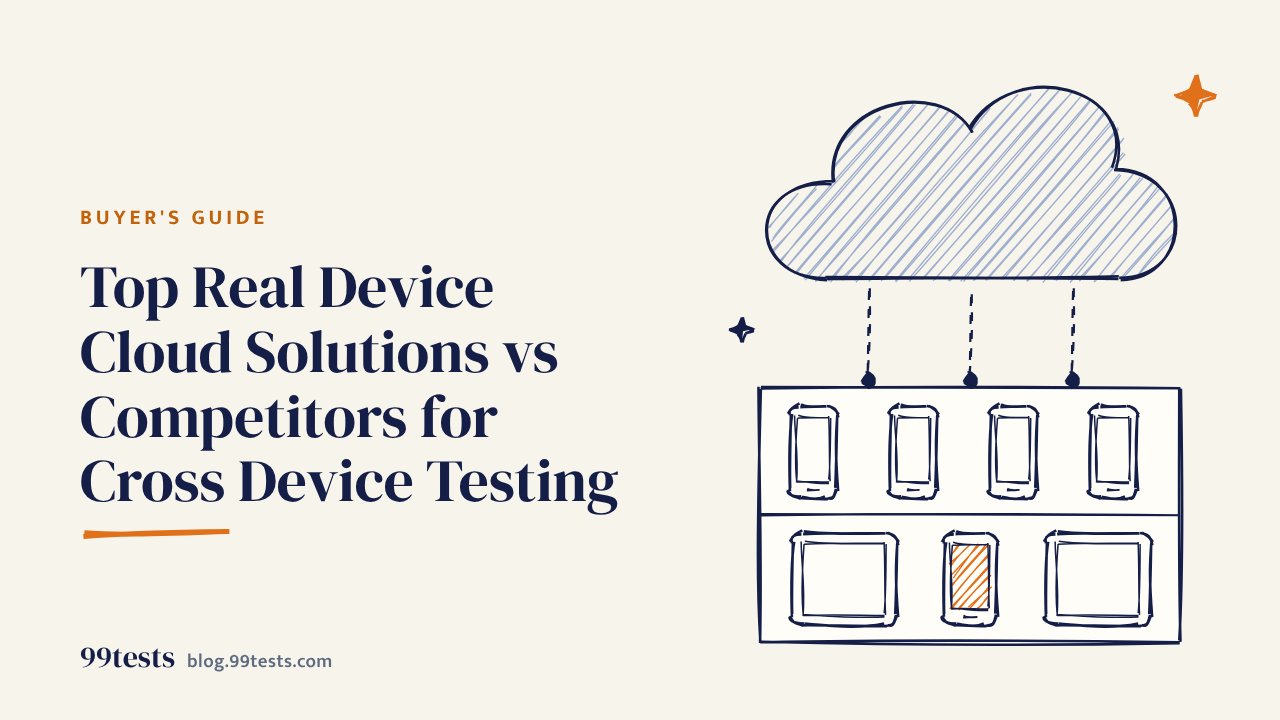
99tests is not a device cloud, and that is why it sits alongside the three platforms above rather than replacing them. Instead of renting remote access to devices in a data center, you send your test cases, including ones written by AI tools, and 99tests assigns them to testers who run them on their own phones, laptops and browsers, on their own home and mobile networks. You choose device brands, minimum OS versions and browser targets; testers come from a registered pool of 20,000 across India.
Every finding goes through a separate verification step: duplicates are merged, reports are checked for completeness, and severity is graded against a published rubric. The report shows each case by device as passed, failed, blocked or not run, with the reason for anything not run. Pricing is fixed per job with no hourly overages, and coding agents can order a run through the 99tests MCP server.
It fits teams whose users are on budget Android phones and patchy mobile networks, and teams whose test cases come from AI tools and need a person to confirm they actually pass on a real device.
Verdict: Which Platform Fits Your Engineering Organization?
Choosing the right platform depends entirely on where your team hits friction.
If your developers live in their IDEs and need immediate manual inspection tools alongside rock-solid automation grids, go with BrowserStack [1].
If your QA department manages massive compliance requirements across thousands of unique mobile form factors and requires stringent error reporting, Sauce Labs is the pragmatic pick [2].
If you are betting heavily on natural language test generation and want to unify web, mobile, and API testing under one platform, TestMu AI provides the right tooling [3].
If you need people to execute your test cases on the exact phones and networks your users have, rather than a device lab your engineers drive themselves, add 99tests alongside whichever cloud you choose.
Frequently Asked Questions
What is a real device cloud in cross-device testing?
A real device cloud is a remote infrastructure containing physical smartphones, tablets, and computers that engineering teams can access via the cloud to run manual and automated tests without maintaining physical hardware labs.
How do AI capabilities improve enterprise test automation?
AI tools in modern testing platforms help generate test scripts from natural language prompts, automatically heal broken locators when UI changes occur, and categorize failure patterns to accelerate root-cause analysis [2] [3].
Why use real devices instead of emulators or simulators?
Emulators miss hardware-specific quirks, touch event latency, true graphics rendering performance, and network interactions that only physical Android and iOS devices accurately reproduce.