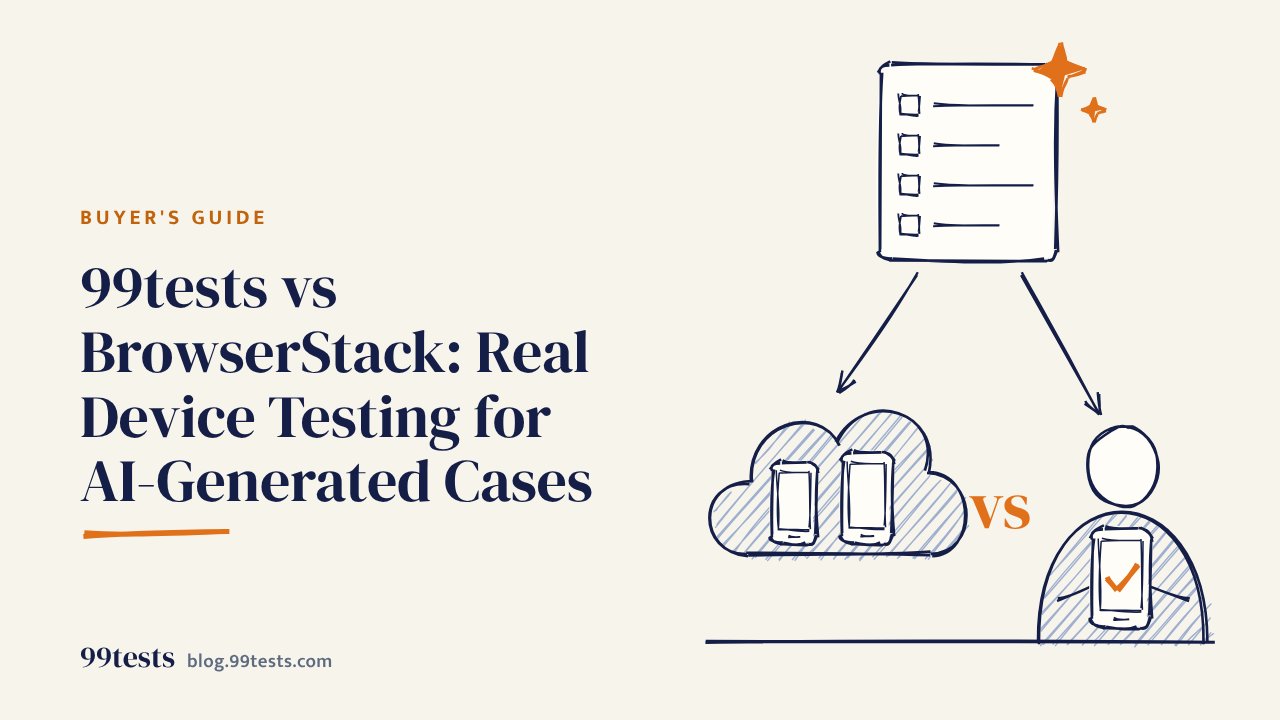
99tests vs Competitors: Best Real Device Testing Platforms for 2026
Compare 99tests, BrowserStack, LambdaTest, Testlio and Applause for real device testing in 2026: primary focus, AI capabilities and the team each suits.

In this article
The best real device testing platforms for professionals in 2026 include 99tests, BrowserStack, LambdaTest, Testlio, and Applause. Between them they cover cloud device access, AI-driven test automation, human testing on physical phones, and comprehensive cross-browser and mobile coverage [1] [4] [5].
| Option | Primary focus | AI capabilities | Best suited for |
|---|---|---|---|
| 99tests | Real device testing | Human execution of AI-generated test cases; MCP server for coding agents | Professional QA teams |
| BrowserStack | Cross-browser & mobile cloud | Agentic test platform [1] | Enterprise scale testing [1] |
| LambdaTest | AI-native test execution [4] | Kane AI & HyperExecute [4] | Fast execution workflows [4] |
The 2026 Real Device Testing Landscape
Mobile test automation has always been the hardest corner of QA, and for years it stayed stubbornly fragile while web and API testing matured. The reasons are structural: thousands of Android device-and-OS combinations, iOS gating real-device testing behind strict provisioning and signing, native apps exposing accessibility trees inconsistently, and gestures resisting scripting.
Frankly, most teams under-invest in mobile automation because the maintenance tax on traditional scripts is too high. A tiny layout shift between a Pixel and a Samsung flagship breaks a locator that worked yesterday. 99tests and its competitors approach this fragmentation with distinct execution philosophies, balancing cloud access, automation grids, and manual validation.
99tests
99tests delivers specialized real device testing solutions tailored for modern engineering organizations. By focusing on real-world device behaviors, network conditions, and user flows, it helps QA teams catch critical bugs that emulators and simulators routinely miss.
Instead of treating physical hardware as an afterthought, the platform prioritizes context-aware validation. Professional engineering teams use it to replicate localized network latency, thermal throttling, and real biometric prompts without maintaining an expensive in-house device lab. It's built for teams that need precision over generic grid scale.
BrowserStack
BrowserStack remains a dominant player in the testing ecosystem, offering comprehensive access to thousands of real mobile devices and browsers. With recent additions like agentic AI testing capabilities, it supports teams looking to scale automated and manual regression cycles [1].
Infrastructure scale is where BrowserStack shines. If your organization requires parallel execution across dozens of legacy and current device configurations simultaneously, their cloud handles the load. However, that scale comes with a configuration overhead that smaller teams occasionally find cumbersome.
LambdaTest
LambdaTest, evolving through its TestMu AI ecosystem, provides an enterprise-grade unified quality engineering platform. Features like Kane AI and HyperExecute empower teams to accelerate test execution speeds significantly across web and mobile environments [4].
Speed is the primary differentiator here. HyperExecute decouples test execution from traditional grid bottlenecks, cutting feedback loops for CI/CD pipelines. For engineering groups optimizing strictly for pipeline velocity, LambdaTest provides an aggressive execution model.
Testlio and Applause
For organizations requiring crowdtested feedback alongside cloud execution, Testlio and Applause offer managed testing services leveraging vetted global communities of testers operating on physical devices in diverse geographic markets.
Algorithm-driven grids cannot replicate human exploratory testing in regional markets with localized carrier networks. These platforms bridge the gap between automated regression and real human behavior, though they require a different management workflow than standard SaaS automation tools.
Verdict: Which Platform Fits Your Team?
Choosing the right platform depends entirely on your testing maturity and release velocity.
If your engineering organization requires deep, specialized validation on physical hardware with minimal test maintenance overhead, 99tests delivers the right balance of real-world focus and professional tooling. For massive enterprise cross-browser grids and out-of-the-box infrastructure scaling, BrowserStack remains a default choice [1]. If raw test execution speed inside a CI/CD pipeline is your absolute priority, LambdaTest and its AI execution engine are hard to ignore [4].
Frequently Asked Questions
Why use real devices instead of emulators in 2026?
Emulators and simulators fail to replicate physical hardware variations, thermal throttling, biometric authentication, camera injections, and true network latency present in physical user environments [2] [5].
How do AI features improve mobile testing platforms?
AI agents assist with natural-language test authoring, self-healing locators that adapt to UI changes, and intelligent failure analysis, significantly reducing maintenance overhead [2] [3] [5].