Is risk-based testing better? How to decide what to test first
Risk-based testing ranks features by how likely they are to fail and how much a failure would hurt, so limited testing time goes where it matters most.
In this article
Originally published 2013. Rewritten October 2026.
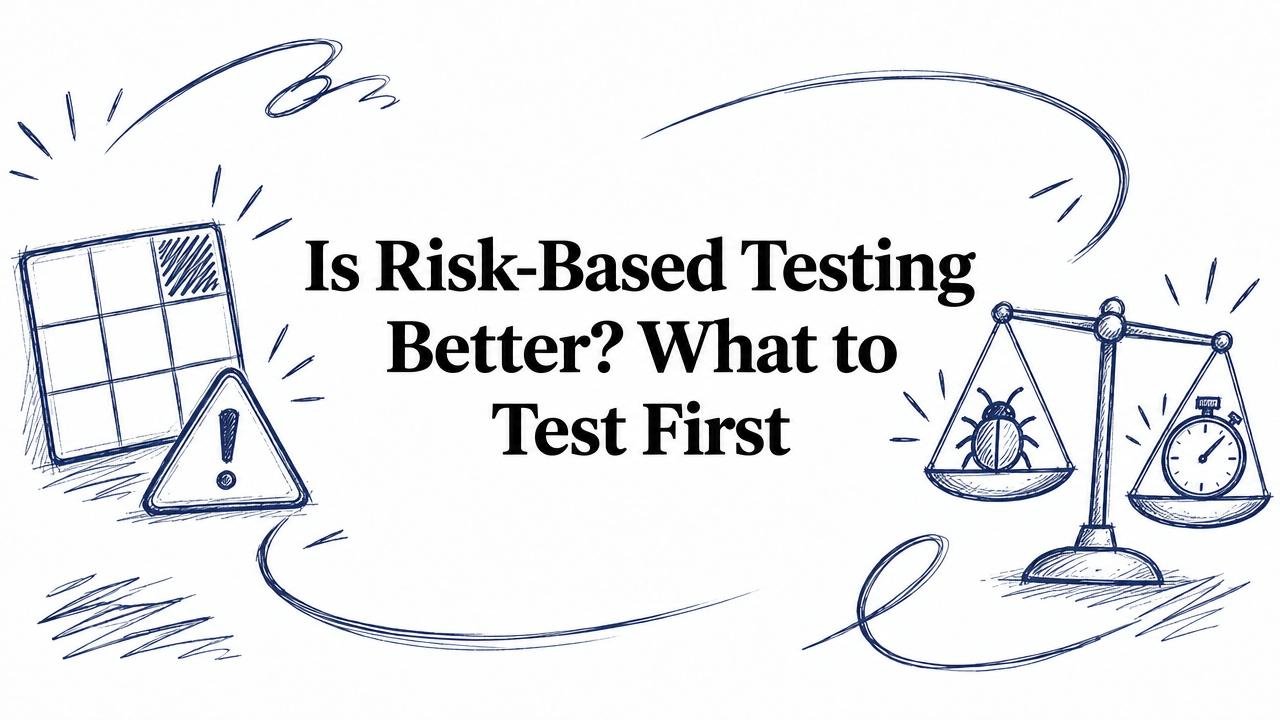
Yes, especially when time or budget is limited. Risk-based testing ranks what to test by two things: how likely each part of the app is to break, and how much it would hurt if it did. You test the top of the list hardest and accept lighter coverage at the bottom. Full coverage sounds safer, but no team actually achieves it. Risk-based testing makes the trade-off on purpose instead of by accident.
That does not mean ignoring everything outside the top few flows. It means deciding, before the session starts, whether checkout needs a full set of cases across devices while a profile photo change needs only a quick check. The answer can change with the next release.
Score the risk in fifteen minutes
List the user flows in the release. Keep the list specific enough to test: "pay with UPI at checkout" is more useful than "payments," because it names the path a tester will take. For each flow, give two scores from 1 to 3. A 1 means low, a 2 means moderate, and a 3 means high.
Likelihood of failure. Score higher when:
- The code is new or was heavily changed. A redesigned checkout is a stronger candidate for testing than an unchanged help page.
- The flow is complex, with many steps, states or integrations. An upload that pauses, retries and resumes has more ways to go wrong than a static profile field.
- A dependency changed: an SDK, an OS version, a payment gateway. Even if your own code barely moved, the flow may behave differently.
- The flow behaves differently across devices, such as camera, file upload or background sync.
- It has broken before. A bug that keeps returning is a useful warning, not just history.
Impact if it fails. Score higher when:
- Money moves, such as payments, refunds or wallets. A failure might leave a user unsure whether they were charged.
- Data could be lost or exposed. Losing an in-progress form matters even if the app stays open.
- A regulator or contract cares about it. A rare failure can still have serious consequences.
- Many users hit it, or hit it first, as with signup and login. A login bug blocks everything behind it.
- A failure would show up in public reviews, particularly when users cannot complete a task they came to do.
Multiply the two scores. The result runs from 1 to 9. For a quick first pass, use the evidence you already have: the change log, recent bugs, crash reports and support themes. If two people disagree, note why. A disagreement about impact may reveal that one person knows about a customer or contract the other does not.
Copyable risk-scoring template
Duplicate this table for each release. Score likelihood and impact from 1 (low) to 3 (high), then multiply them. Name a testable path rather than a broad feature, and record the evidence behind each score so the next release team can revisit it.
| Release: ______ | Target devices or environments: ______ | Scored on: ______ |
|---|
| User flow | Likelihood (1-3) | Impact (1-3) | Risk (L x I) | Reason or evidence | Planned coverage | Owner |
|---|---|---|---|---|---|---|
| [Specific path and outcome] | [1-3] | [1-3] | [1-9] | [Change, past bug, dependency or user impact] | [Cases, charter, devices, smoke check or skip] | [Name] |
| [Specific path and outcome] | [1-3] | [1-3] | [1-9] | [Change, past bug, dependency or user impact] | [Cases, charter, devices, smoke check or skip] | [Name] |
| [Specific path and outcome] | [1-3] | [1-3] | [1-9] | [Change, past bug, dependency or user impact] | [Cases, charter, devices, smoke check or skip] | [Name] |
Before testing starts: Review tied scores, flag any high-impact flow even if its likelihood is low, and write down what you will skip. Re-score a row if a late fix, new dependency or test finding changes the risk.
An example
Here's how a consumer app might score one release:
| Flow | Likelihood | Impact | Risk |
|---|---|---|---|
| UPI payment at checkout | 3 | 3 | 9 |
| Signup with OTP | 2 | 3 | 6 |
| KYC document upload | 3 | 2 | 6 |
| Search and filters | 2 | 2 | 4 |
| Referral code | 2 | 1 | 2 |
| Profile photo | 1 | 1 | 1 |
The payment flow lands at 9 if the gateway integration changed and a failure could stop a purchase. OTP signup scores 6 even without a major rewrite: a failed code delivery or retry can prevent a new user from getting into the app. Document upload also scores 6, but for a different reason. Camera permissions, file size and a dropped connection give testers several possible failure points.
A profile photo scores 1 here because it is unchanged and a failure has limited effect. That score is not permanent. If this release replaces the image picker, its likelihood should go up. The table is a decision for this release, not a label attached to the feature forever.
Turn the scores into a plan
- Risk 6 to 9: run scripted cases and an exploratory charter on every target device, including a budget Android on a mobile network. For checkout, scripted cases might cover success, cancellation and retry; a charter can ask testers to look for confusing states after a connection drops.
- Risk 3 to 4: run scripted cases on two devices. For search, check common queries, empty results and filter combinations, then look at whether the results still make sense on a smaller screen.
- Risk 1 to 2: do a quick smoke check, or skip it this release and note that you did. A profile photo smoke check might mean selecting one image and confirming it saves.
These are starting points, not a rule that every release must follow. A score of 6 may deserve extra attention when the team has seen the same bug twice. If you have only one budget device available, put it on the flow where memory, network or battery behavior is most likely to matter.
Write the scores and the reason for each one next to the plan. Also record which flows were skipped. When something breaks later, you'll be able to see whether the scoring was wrong, the chosen tests missed the failure, or the flow changed after the plan was made.
Where risk-based testing goes wrong
- Scoring by gut feel. Use what you know: the change log, past bugs, crash reports and app store reviews. If a flow feels risky but the evidence is thin, say so rather than presenting the score as certain.
- Ignoring device risk. The same flow can be low risk on a flagship and high risk on a phone with 3 GB of RAM and an aggressive battery saver. For example, a document upload may work on office Wi-Fi but stall when the app moves to the background on a mobile network.
- Never re-scoring. Risk changes with every release. A flow that was safe last month may sit on new code this month. Revisit the list when the release scope changes, not just when testing begins.
- Skipping the bottom of the list forever. Rotate low-risk flows into testing every few releases, or problems pile up there unnoticed. A simple rotation gives a neglected feature a turn without pretending it needs the same depth as checkout every time.
One more trap is treating a score as proof that a flow works. The number helps allocate effort; it does not replace test results. If a tester finds a serious issue in a lower-ranked flow, adjust the plan while there is still time.
Using it with crowd testing
Crowd testing sessions are timed, so the risk ranking decides how testers spend their minutes. Give the highest-risk flows written cases and an exploratory charter, and put them on the devices most likely to break them. For a payments flow in India, that means at least one budget Android on a mobile network, not only the newest iPhone.
Make the brief concrete. Instead of "test payments," ask testers to complete a payment, cancel one, and investigate what the app shows if they switch networks before confirmation. For document upload, ask them to try a camera capture and a file selection, then note what happens if they leave and return to the app. Those prompts give testers direction without limiting them to a single expected path.
When the session ends, compare findings with the original scores. If testers found repeated failures in a flow scored 2, ask whether the likelihood estimate missed a device, dependency or recent change. That makes the next risk ranking more useful.
At 99tests you can mix scripted cases and charters in one job. See how exploratory sessions work and the packages.
Is it better than trying to test everything?
Trying to test everything usually means testing everything a little, which leaves the riskiest flows under-tested. Risk-based testing is better when you have to choose where limited time goes. It gives checkout, login or data-handling flows a stronger test than a low-impact cosmetic change, while making that choice visible to the team.
It is not a reason to stop testing the rest of the app. Pair it with automated regression tests for stable behavior, rotate lower-risk flows into manual checks, and use human sessions for risky paths that need judgment or behave differently across devices. Before release, look once more at what changed after scoring. If a late fix touches a low-ranked flow, that flow may no longer belong at the bottom of the list.