1 in 9 Play Store reviews of India's top apps describe a broken app
We read 2,961 Google Play reviews of 187 top Indian apps in six languages. 10.7% describe a broken app; money apps run at nearly twice the rate.
In this article
- How we built the report
- Which apps and languages
- How each review was coded
- What breaks: features first, then crashes
- Money apps show nearly twice the bug reports
- Why banking apps break where they do
- Failed payments mostly happen outside payment apps
- What these reviews describe
- Government service apps run at more than twice the average
- Developers reply fast, mostly with a template
- The missing detail is the phone
- Release notes and star ratings tell users little
- 44% of release notes say nothing specific
- Star ratings barely track bugs
- Language and category patterns
- Hindi reviews are the most critical, mostly about service
- Quick commerce and shopping barely mention malfunctions
- The lowest-rated app in each category
- What app teams can do this quarter
- Get the data and cite the report
- Test your app on the phones your users carry
We read every review Google Play shows on the store pages of 187 of India's most-used apps: 2,961 reviews in English, Hindi, Bengali, Marathi, Telugu and Tamil. 10.7% of them describe the app malfunctioning: crashes, OTPs that never arrive, payments debited but not credited, features that don't work.
That is roughly one in nine of the reviews a would-be user sees before deciding to install. The problem is not spread evenly. Money apps run at nearly twice the rate of other apps, and government service apps at more than twice the average.
This post walks through the India App Quality Report, Q4 2026: how we built it, the findings that matter most for app teams, and what to do about them this quarter. The full report, method and both datasets are free to reuse under CC BY 4.0.
How we built the report
On 23 October 2026 we loaded the India store page of each app on Google Play and recorded every review shown on it. These storefront reviews are the handful Google picks as most relevant. They are the first thing a person reads before deciding to install.
Which apps and languages
- 187 apps across 16 categories: the most-installed consumer apps serving India, government services included. 189 were planned; Fi Money and Doubtnut are no longer listed on Google Play.
- Six languages: every app was read in English and Hindi. Apps with 1 crore (10 million) or more installs were also read in Bengali, Marathi, Telugu and Tamil.
- Up to three reviews per language: up to 18 per large app and 6 for the rest, 2,961 reviews in all. We also recorded each app's rating, install band, last update date and release notes.
How each review was coded
Each review was coded against a written codebook: its language, sentiment, the one main problem it describes, whether that problem is a software malfunction, whether it started after an update, any phone or Android version named, and the type of developer reply.
A review counts as a malfunction when its main problem is a crash or freeze, a login or OTP failure, a payment failure, a feature that doesn't work, slowness, or wrong data. Complaints about fees, support, delivery, refunds or loan decisions are recorded but not counted.
An AI model did the coding, working from each review in its original language. A second AI coder that had not seen the first coding re-coded 63 random reviews from 14 apps. The two agreed on whether a review describes a malfunction 92.1% of the time (Cohen's κ = 0.78).
Limits worth knowing. Storefront reviews are Google's selection, not a random sample, and they lean toward long, upvoted reviews. The median review was 92 days old. Per-app figures are small samples: treat them as a snapshot of 23 October 2026, not a verdict on any app.
Disclosure: 99tests sells app testing. Some companies in the dataset are or have been 99tests customers; every app was read and coded the same way.
What breaks: features first, then crashes
Of the 317 malfunction reviews, 30.9% describe a feature that doesn't work: an upload, a search, a booking or cancel button, playback, notifications. Crashes and freezes come next, then login and OTP failures, then failed payments.
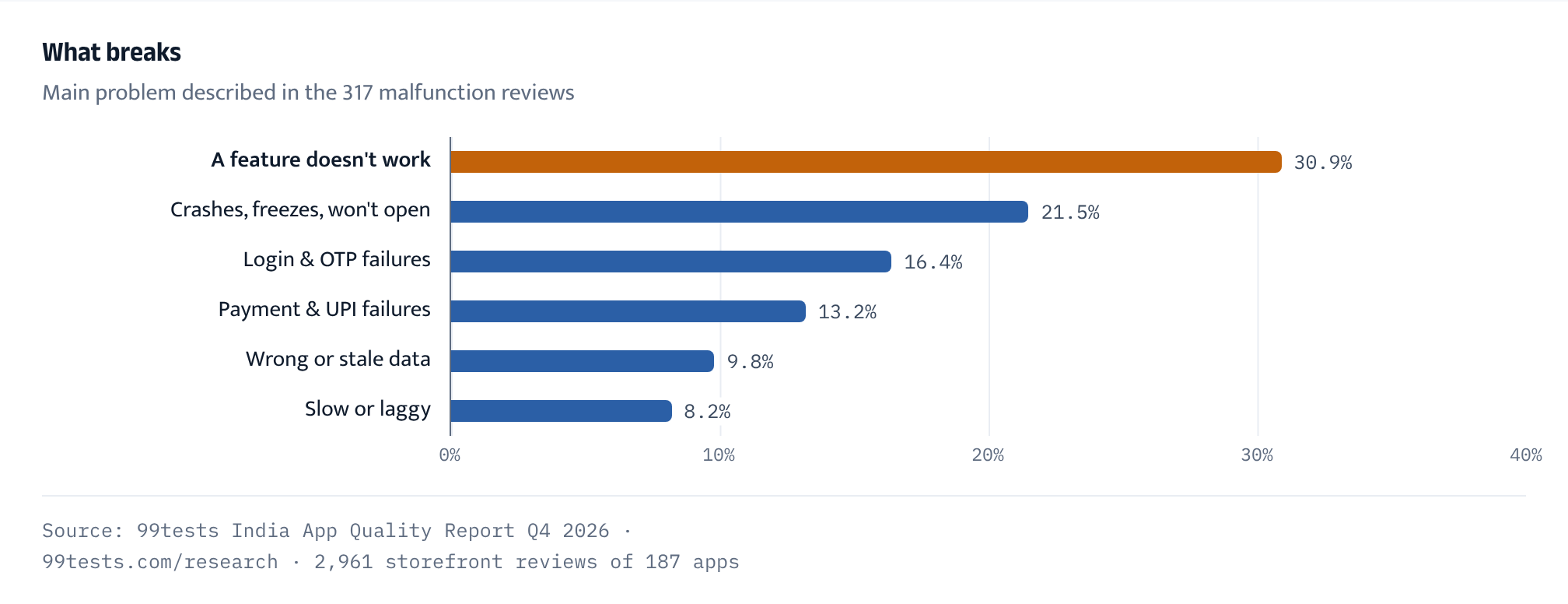
Malfunctions are only part of what people complain about. Of all complaints on these storefronts, 30.8% are software failures, 53.4% are about service, fees, support or delivery, and 15.8% are about design, ads or missing features.
Money apps show nearly twice the bug reports
Banking, UPI, lending, investing and insurance apps together run at a 15.5% storefront bug rate, against 8.3% for every other category. That is 1.9 times the rate.
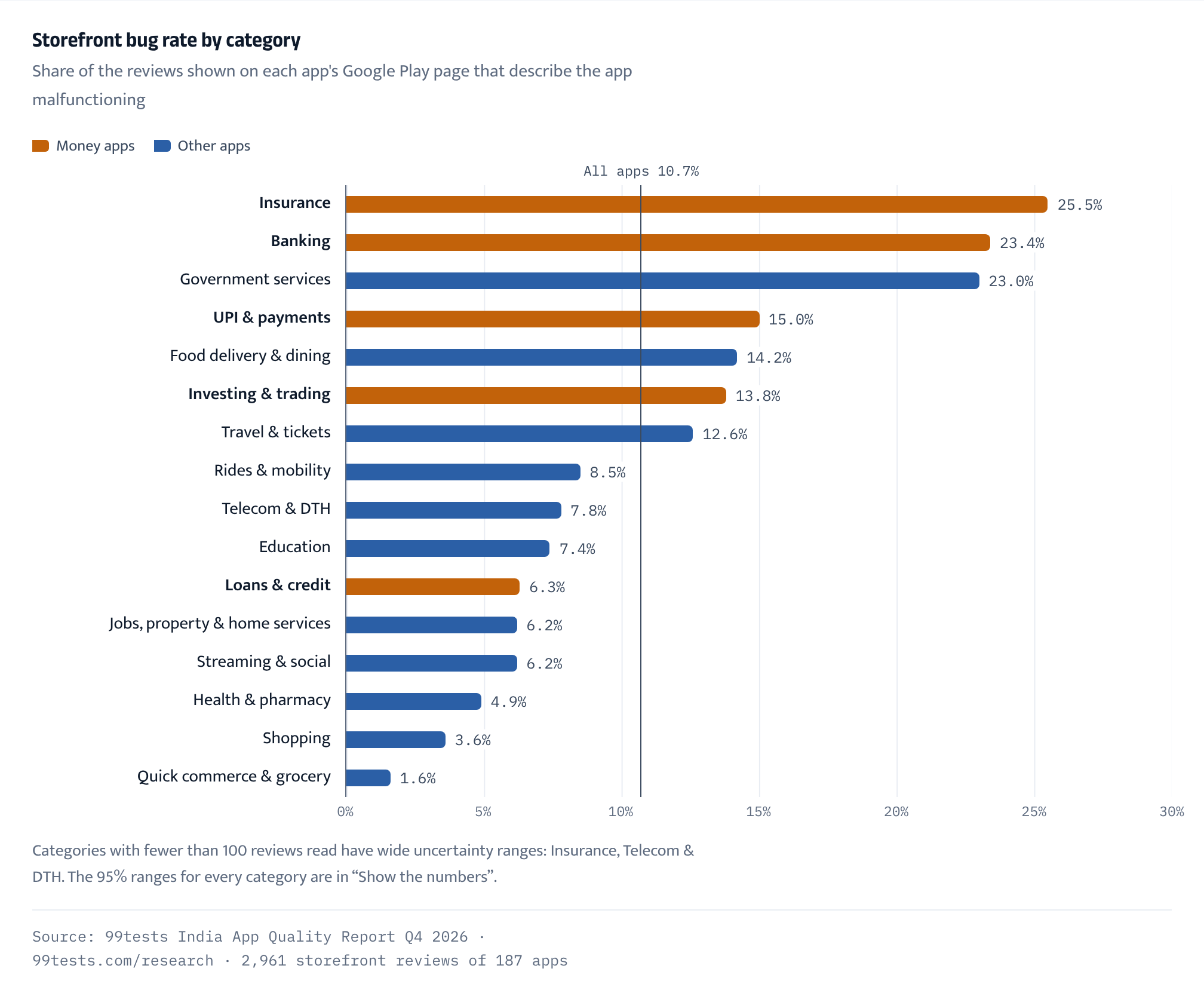
Storefront bug rate: the share of the reviews on an app's Google Play page that describe the app malfunctioning.
Banking leads the large categories at 23.4%, about 1 in 4 reviews, and 10 of its 11 apps had at least one malfunction review on show. Insurance reads higher at 25.5%, but on only 98 reviews, so its range is wide.
Why banking apps break where they do
Login and OTP failures peak in banking, at 7.1% of reviews. Device binding, MPINs and SIM checks add steps that can fail, and each behaves differently across phones, Android builds and SIM setups. Crashes and freezes are just as common, at 8.1%.
Union Bank of India's storefront had the highest share among large apps: 11 of its 18 reviews describe a malfunction, 9 of them crashes or the app failing to open. The app is rated 3.6★.
Failed payments mostly happen outside payment apps
Of the 42 reviews describing a failed, stuck or double-debited payment, 34 are on apps other than UPI, payment and banking apps. Travel apps account for 11 and lending apps for 6. UPI, payment and banking apps account for 8.
The pattern repeats: the payment sits inside another app's booking, order or loan repayment. The money leaves the account, the app shows a failure or nothing, and the booking or order doesn't go through.
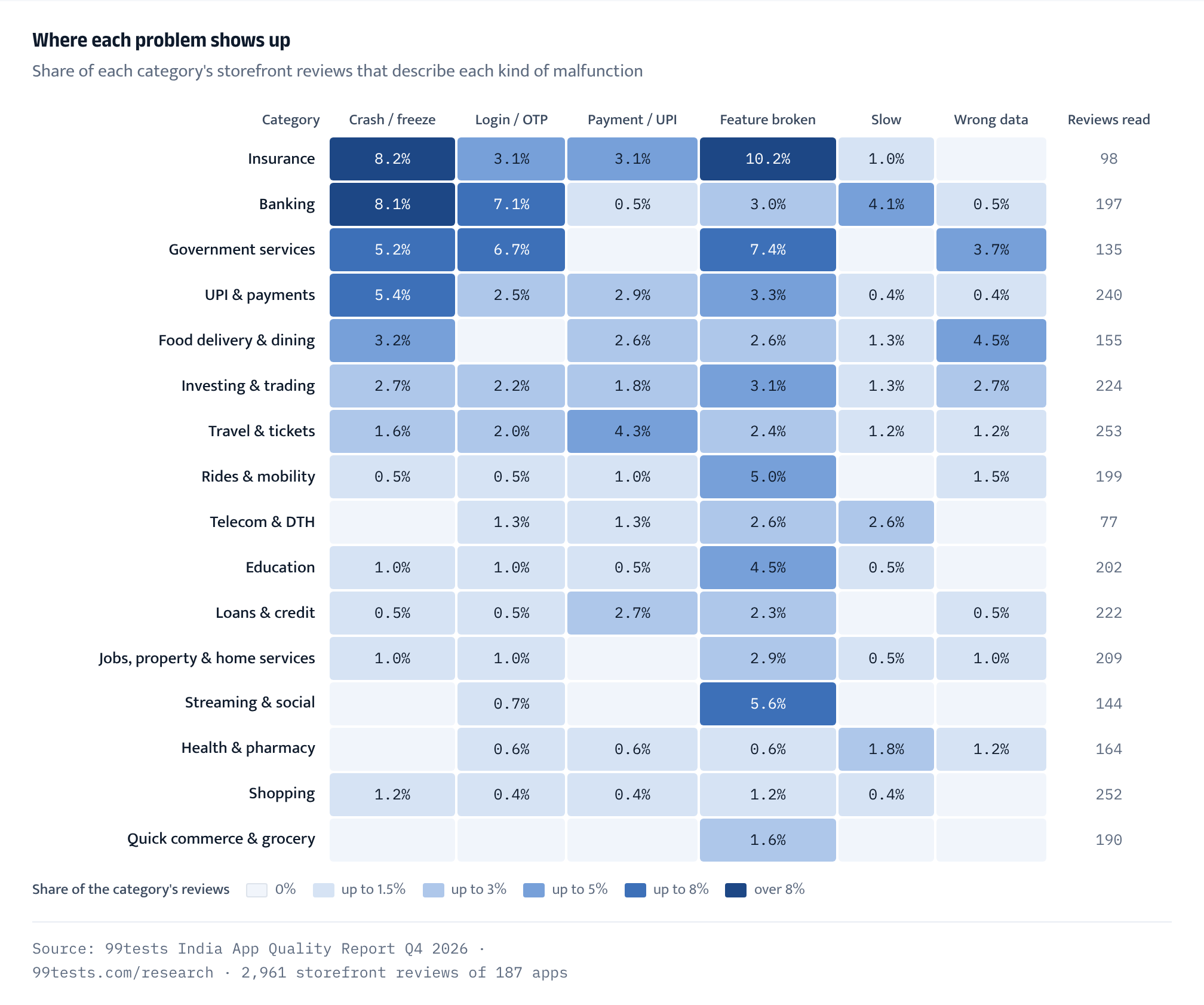
Per review, travel apps show failed payments most often, at 4.3% of their storefront reviews. The 14 UPI and payment apps run at 2.9%, and their most common malfunction is crashes and freezes.
What these reviews describe
| App | Category | What the reviewer describes | Posted |
|---|---|---|---|
| IRCTC Rail Connect | Travel | Money deducted twice while the ticket showed failed; the refund took five days | Sep 2026 |
| Zomato | Food | Order payment failed with no confirmation or alert (428 helpful votes) | Sep 2026 |
| mPokket | Loans | Repayment failed on the due date, then an auto-debit added a penalty | Sep 2026 |
| Zerodha Kite | Investing | Funds debited from the bank but not credited to the account | Jul 2026 |
| Yatra | Travel | Hotel booking amount debited, booking not confirmed | Nov 2025 |
Reviews paraphrased in our own words.
Some of these failures start at the bank or the payment network rather than in the app. To the user, the app is where it broke.
Government service apps run at more than twice the average
The 8 government service apps show a 23.0% storefront bug rate: 31 of their 135 reviews describe a malfunction, against 10.7% across all apps. Every one of the 8 had at least one malfunction review on show.
- NextGen mParivahan: 7 of 18 storefront reviews describe a malfunction, most often login and OTP failures. At 3.7★ it is the lowest-rated app in the category.
- UMANG: 6 of 18, also led by login and OTP failures, even though the app is rated 4.5★.
Features that don't work and login or OTP failures are the most common problems on these storefronts, followed by crashes and wrong data. None described a failed payment.
For these apps a failed sign-in isn't a lost sale. It's a person who can't reach a document or a service they need.
Developers reply fast, mostly with a template
71.0% of malfunction reviews have a developer reply, usually posted the same day. But 76.9% of those replies are boilerplate: sorry for the inconvenience, write to our support address, share your registered number.
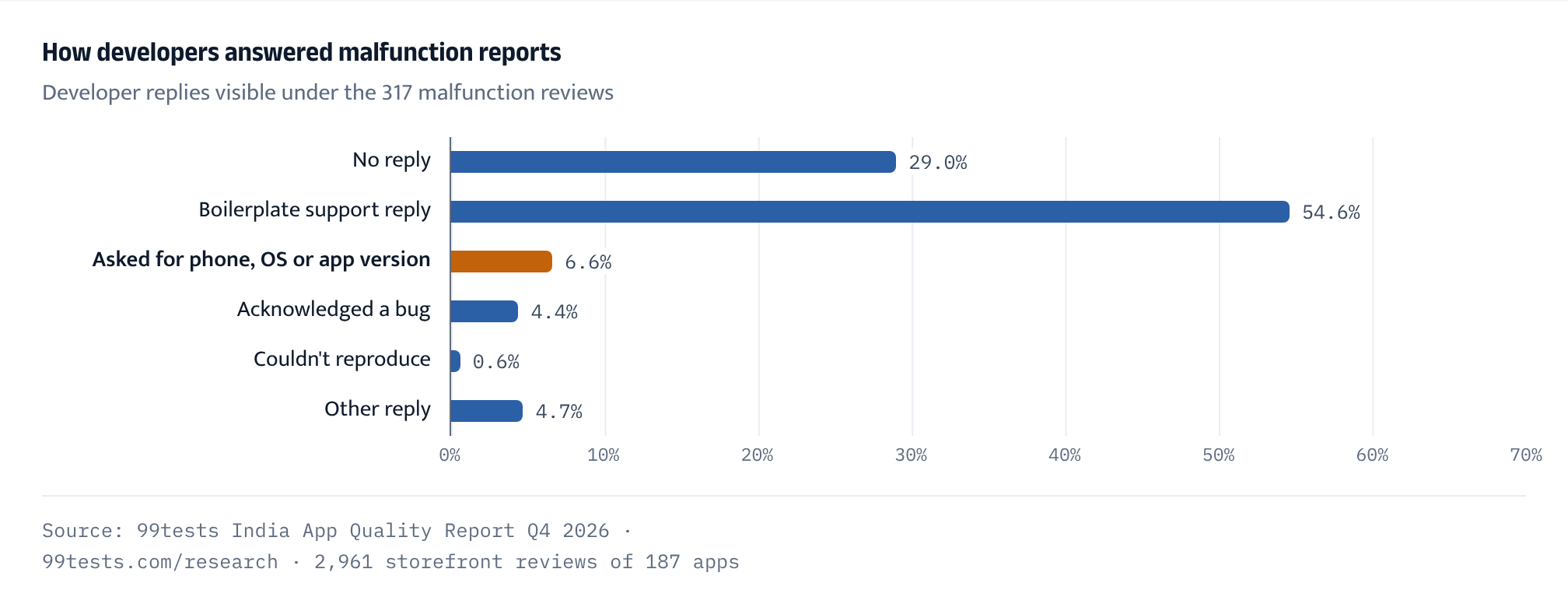
Only 14 replies acknowledged a bug or promised a fix in an update. 21 asked for the phone model, Android version, app version or a screenshot.
The missing detail is the phone
Only 7 of 317 malfunction reviews (2.2%) name the device or OS version the reviewer was using. Users describe what broke, not where it broke.
A bug that appears only on one manufacturer's Android build reaches the team as "the app doesn't work". The team's first reply then has to ask which phone it was.
Reply with a question, not a template. Asking for the phone model, Android version and app version in the first public reply turns a complaint into a bug report you can reproduce.
Release notes and star ratings tell users little
44% of release notes say nothing specific
For 70 of the 159 apps that show release notes, the latest one says only a version of "bug fixes and performance improvements". These apps ship often: the median app had updated 28 days before we read it, and 67.4% had shipped in the previous 30 days.
15 malfunction reviews (4.7%) say the problem started after an update, 6 of them on banking apps. These are regressions: the previous version worked.
Star ratings barely track bugs
The median app is rated 4.5★, and only 12 of the 187 sit below 4. Across the 158 large apps, the rank correlation between rating and storefront bug rate is −0.19 (Spearman), a weak relationship.
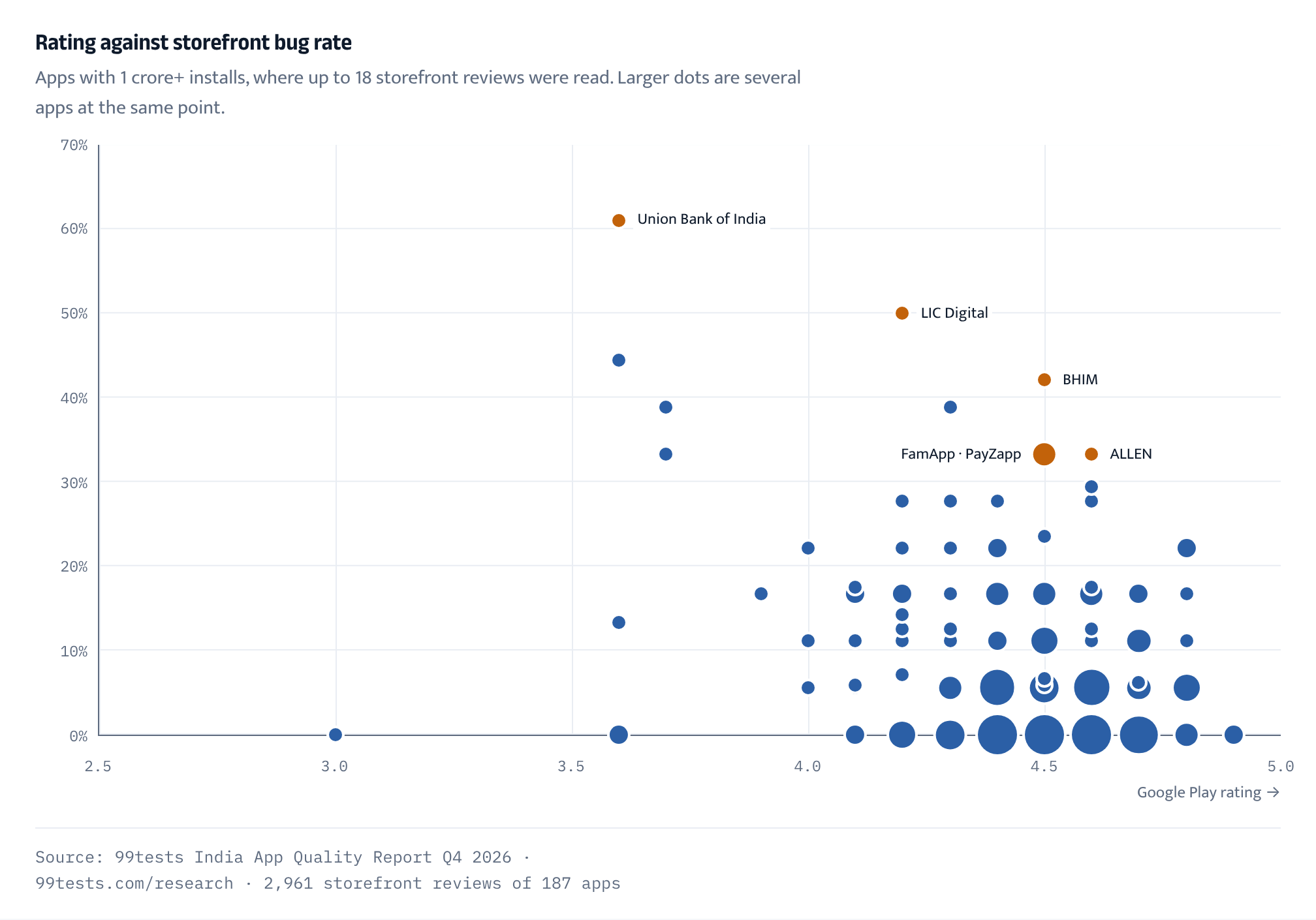
10 apps rated 4.5★ or higher have malfunction reviews in at least 1 in 5 of their storefront slots. BHIM (4.5★) shows 8 of 19; FamApp and PayZapp, both 4.5★, show 6 of 18.
It cuts the other way too. PaySense, the lowest-rated money app at 3.0★, had no malfunction reviews on show at all. A rating blends everything users feel about a service; the reviews say what broke.
Language and category patterns
Hindi reviews are the most critical, mostly about service
49.8% of Hindi storefront reviews are negative, against 32.2% for English. Much of that is about service, fees and support: 31.8% of Hindi reviews raise it, against 18.0% of English ones.
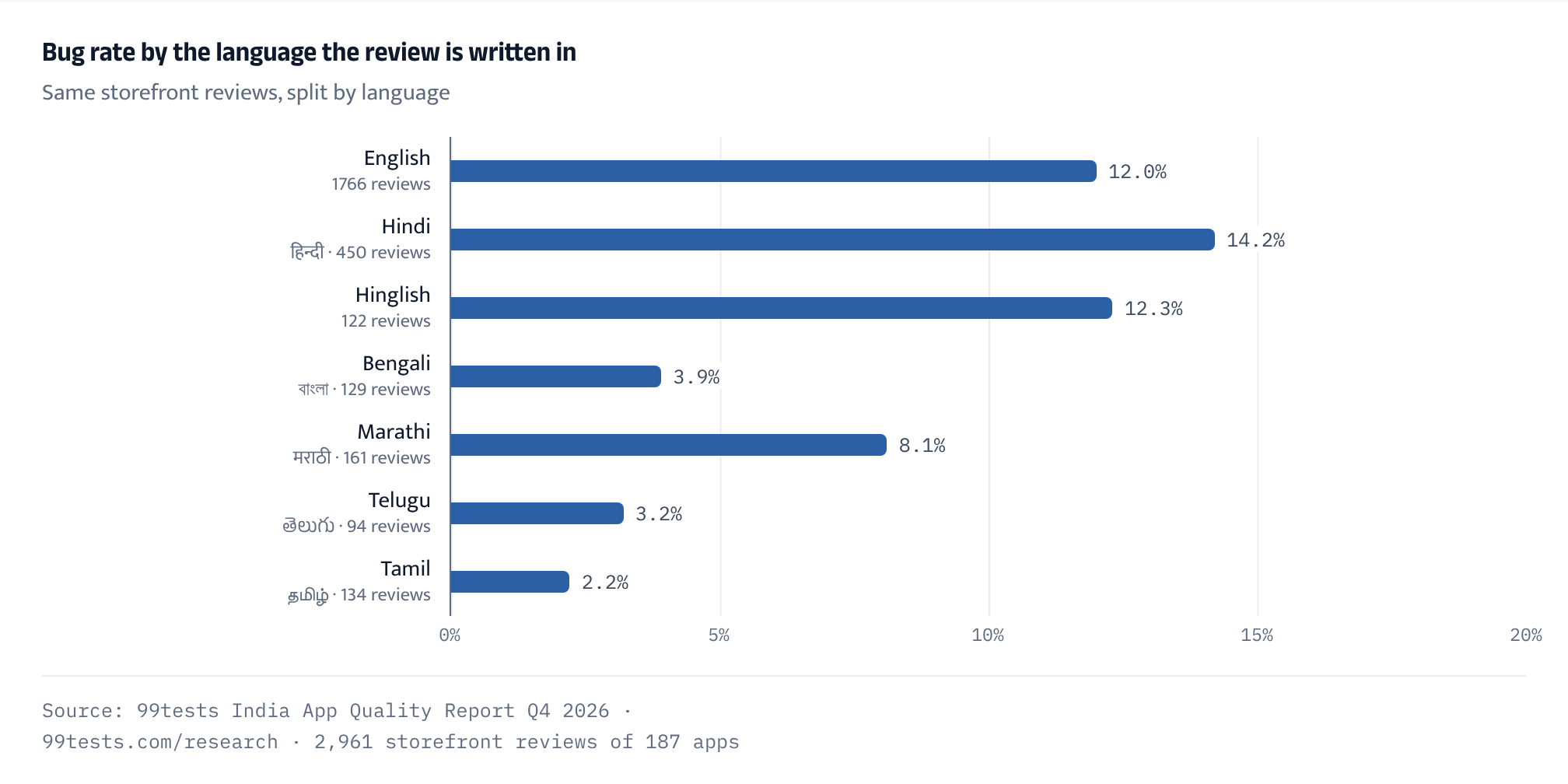
In Bengali, Marathi, Telugu and Tamil, the reviews Google shows are mostly short praise, and only 4.6% describe a malfunction. Within the 162 apps read in all six languages, Indian-language reviews describe malfunctions slightly less often than English ones: 8.8% against 11.1%.
Quick commerce and shopping barely mention malfunctions
Quick commerce and grocery storefronts run at 1.6% and shopping at 3.6%. Their complaints are about the service, not the software: 81.9% concern orders, delivery, refunds, fees or support.
The lowest-rated app in each category
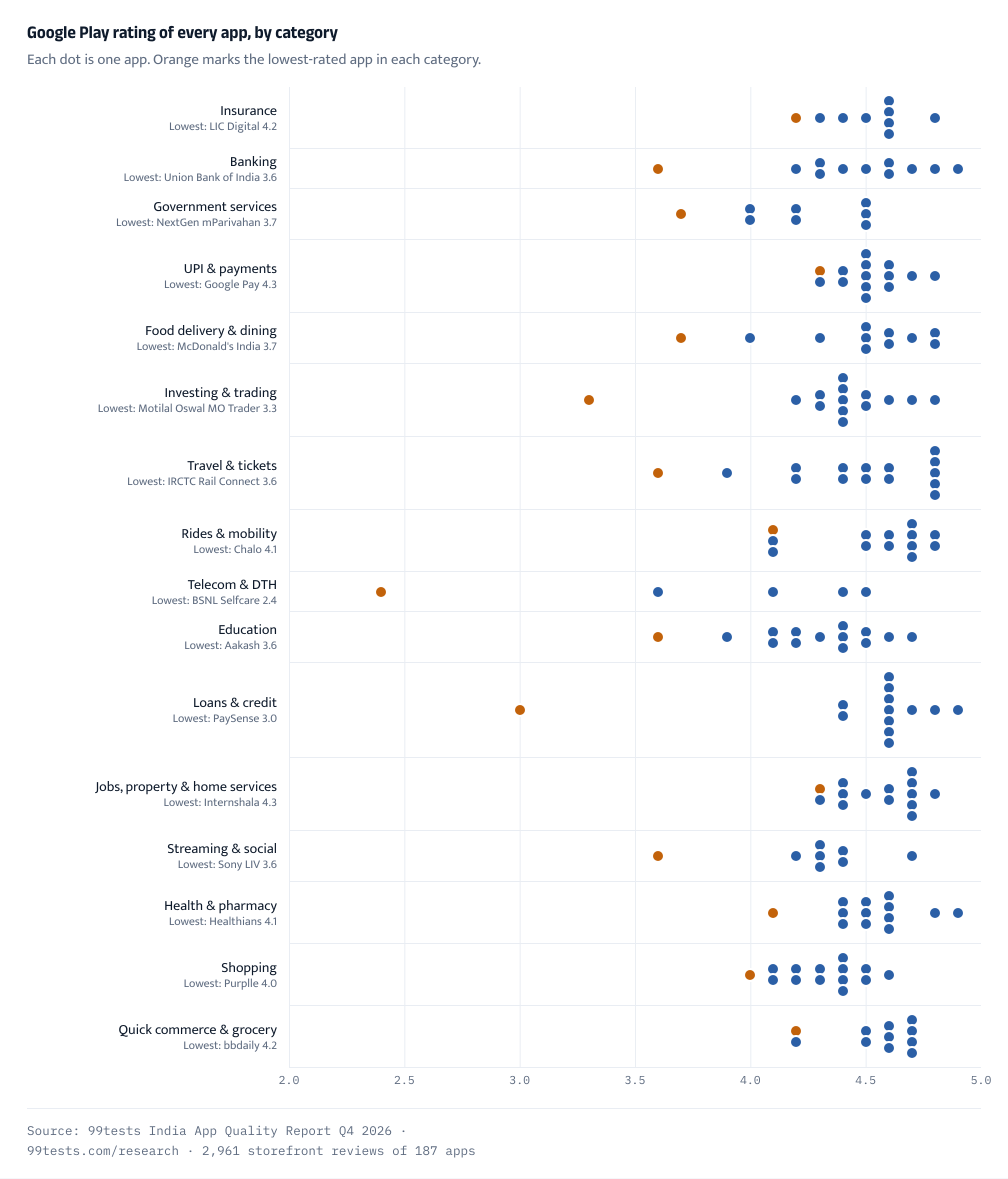
BSNL Selfcare is the lowest-rated app in the edition at 2.4★, followed by PaySense at 3.0★ and Motilal Oswal MO Trader at 3.3★. Ratings bunch in a narrow band near the top, which is why the reviews carry information the stars don't.
What app teams can do this quarter
Each finding points to a check you can run before your next release.
- Test payments inside the whole flow. If your app takes money inside a booking, order or repayment, test the cases where the payment succeeds and the booking fails: timeouts, retries, double taps, refunds and the confirmation screen.
- Test login and OTP on the phones your users carry. Device binding, SIM checks, OTP auto-read and biometrics behave differently across manufacturers and Android builds. Cover the budget and mid-range phones in your install base, not just flagships.
- Ask for the device in every reply. Make the phone model, Android version and app version the first question in your reply template, and log the answers beside your crash reports.
- Write release notes that say what changed. "Fixed OTP not arriving on some phones" tells a user who hit the bug to update; "bug fixes and improvements" tells them nothing.
- Re-test what broke last time. 4.7% of malfunction reviews say the problem started after an update. Run login, payments and your top three journeys on real devices before each release.
- Read your storefront in every language you serve. Google shows different reviews in English, Hindi and regional languages. Check each one monthly, the way a new user would see it.
For a step-by-step device workflow, see How to Test an App on Real Devices Without Guesswork.
Get the data and cite the report
Both datasets are free to reuse under CC BY 4.0, with credit to "99tests India App Quality Report" and a link to the report page.
- Apps dataset (CSV, 187 rows): rating, installs, update recency and malfunction counts for each app.
- Coded reviews dataset (CSV, 2,961 rows): language, date, helpful votes, issue type and developer reply type for each review, with no review text or reviewer names.
Every chart on the report page has a "Copy embed code" button that gives you the image with a source link. Journalists and researchers can write to hello@99tests.com for the codebook or a cut of the data. The report comes out every quarter; the next edition is due in late January 2027.
Test your app on the phones your users carry
If your next release touches login, payments or a key journey, 99tests can run it on real phones with testers across India, on the same devices and networks your users have. Pick a test cycle at 99tests.com/pricing, share your build through Google Play internal testing, TestFlight or an APK link, and get the bugs back with device, OS and network details. Plans start at ₹9,999 + GST.
Sources: India App Quality Report Q4 2026 (data read 23 October 2026) and its two datasets.