Testers and Developers Aren't Enemies: How to Build One Team That Ships Better Software
Why testers and developers end up on opposite sides, what each one is really afraid of, and 10 practical habits that turn them into one team: shared done, three amigos, kinder bug reports, pairing and AI-era handoffs.
In this article
- Why good people end up on opposite sides
- What each side is really afraid of
- 10 habits that turn two sides into one team
- 1. Agree on one definition of done
- 2. Meet at the start, not the end
- 3. Write bug reports as a gift, not a verdict
- 4. Describe the bug, never the person
- 5. Replace "can't reproduce" with "let's reproduce it together"
- 6. Triage together, with rules you both wrote
- 7. Teach each other your craft
- 8. Share the test cases before the code is finished
- 9. Celebrate the bug that never shipped
- 10. Decide together how AI-written code gets tested
- A note to developers
- A note to testers
- The one-page working agreement
- Where 99tests fits
It's 11:40 pm, the night before a release.
A tester has just found a bug: on a budget Android phone with a weak signal, the payment screen says failed, but the money has left the account. She writes it up carefully, attaches a screen recording, and marks it P1.
Across the city, a developer sees the notification. He has been on this feature for three weeks. He has fixed eleven bugs today. His first thought isn't "good catch". It's "Not again. Not tonight."
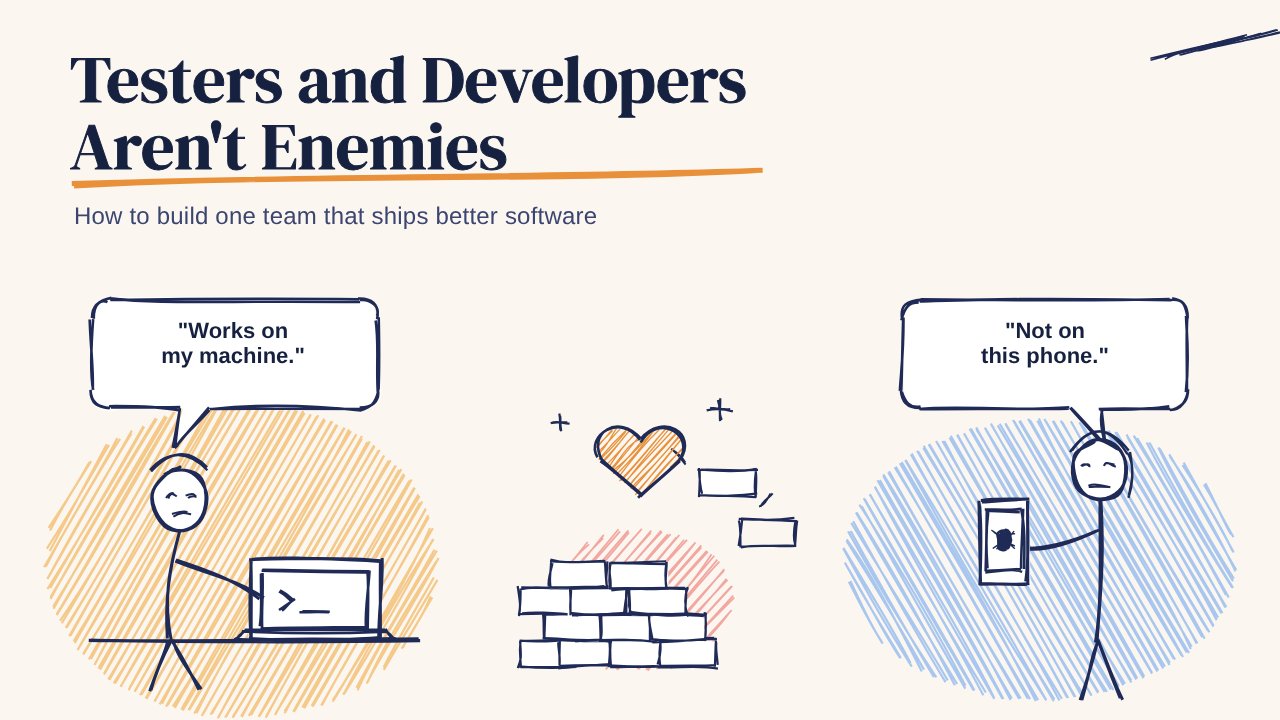
He types: "Works on my machine. Can't reproduce."
She reads it and feels the familiar sting. Two hours of careful work, dismissed in five words. She types back, a little sharper than she means to.
By midnight, two people who both care deeply about the product are on opposite sides of a wall. The release ships anyway. Three days later, the same bug shows up in a one-star Play Store review.
If you've worked in software, you've lived some version of this night. Back in 2018, someone asked on the 99tests community: how do testers and developers work together to improve the software? People still link to that thread, because the problem hasn't gone away. This is our fuller answer.
Why good people end up on opposite sides
Most tester–developer conflict isn't about skill or attitude. It comes from how the work is set up.
- The developer's job is to make something work. Every bug report, however polite, says "it doesn't".
- The tester's job is to find where it breaks. Every "can't reproduce" feels like "you're wrong".
- Both are judged under deadline pressure, usually by different people, with different numbers.
- They meet at the worst moment: the end of the sprint, when everyone is tired and the release date can't move.
Put two thoughtful people in that structure and you'll get friction, every time. The fix isn't to ask them to "communicate better". It's to change where and how they meet.
What each side is really afraid of
It helps to say the quiet part out loud.
What developers fear: being made to look careless. Late surprises that blow up a plan they promised to a manager. Bug reports that are vague and cost an hour just to understand. Being blamed in public for something nobody specified.
What testers fear: being invisible until something breaks. Being treated as the last step instead of a partner. Spending hours on a careful report and getting "works for me". Being blamed when a bug they did report gets shipped anyway.
Read both lists again. They're the same fear: "My work isn't respected, and I'll take the blame." Once a team sees that, collaboration stops being a soft skill and becomes a shared problem to solve.
10 habits that turn two sides into one team
1. Agree on one definition of done
Most arguments start with different ideas of "done". Write it down once and pin it where everyone can see it:
- Code merged and reviewed
- Unit and API tests passing
- Acceptance criteria checked on a real device
- No open P1 bugs
When "done" includes testing, the tester stops being a gate the developer has to get past. They're both working towards the same finish line.
2. Meet at the start, not the end
The midnight scene happens because testers and developers first meet when the code is finished. Move that meeting to the beginning.
Run a 15-minute three amigos session for each story: product, development and testing together, before any code is written. The tester's gift here is the awkward question:
- What happens if the network drops halfway through payment?
- What if the user taps Pay twice?
- What does the user see while the bank is still deciding?
Every question answered here is a bug that never has to be reported, and an argument that never has to happen.
3. Write bug reports as a gift, not a verdict
A bug report is a message from one person to another, often read late at night by someone tired. Make it easy to receive:
- A title that describes behaviour, not blame: "Payment shows failed but amount is debited"
- Numbered steps someone can follow without asking a question
- Expected and actual result, side by side
- Device, OS, app version and network: "Redmi, Android 13, Jio 4G with weak signal"
- A screen recording, because it settles "can't reproduce" in seconds
- Severity, with one line of why it matters to users
A good testing report template turns this into a habit. A clear report says "I respect your time" before the developer has read a word.
4. Describe the bug, never the person
"The app crashes when..." lands very differently from "You broke...". Keep blame out of bug trackers, stand-ups and retros. In a team where nobody gets shamed for a bug, developers start asking testers to look at their work earlier, which is exactly what you want.
5. Replace "can't reproduce" with "let's reproduce it together"
"Can't reproduce" is where most of the hurt happens. Make it a trigger for a conversation, not a closing comment. When a bug only shows up on one phone or one network, get on a call and reproduce it live. Twenty minutes together beats two days of comments, and it often shows why the bug happens, which no report can.
6. Triage together, with rules you both wrote
Arguments about priority are really arguments about whose judgement counts. Agree on the scale in advance:
- P1: blocks money, login, data or a core flow
- P2: important, with a workaround
- P3: polish
Then triage new bugs together for 15 minutes a few times a week. A decision made jointly doesn't get reopened at midnight.
7. Teach each other your craft
Developers can show testers how a feature is built and where it's fragile. Testers can show developers how they explore: which interruptions, devices and edge cases they try first, and why. After a few sessions, developers start catching the obvious bugs themselves, and testers start finding the deep ones.
8. Share the test cases before the code is finished
Give developers the test cases early. Most will run the obvious ones themselves and fix issues before handing over, and nobody feels caught out. The free 99tests test case library is a good shared starting point for common Indian app flows such as UPI payments, OTP login and Aadhaar eKYC.
9. Celebrate the bug that never shipped
Teams usually only talk about bugs when they reach users. Turn that around. When a bug is caught in a three amigos session or before merge, say so in the stand-up, and name both people. A culture that thanks people for finding problems early gets more problems found early.
10. Decide together how AI-written code gets tested
AI coding agents now write features and their tests in minutes. That can make the old wall higher ("the tests passed, so it works") or tear it down, depending on how the team handles it.
- Developers: check that AI-written tests would actually fail if the feature broke. Many only confirm what the code already does.
- Testers: spend your time where AI tests are weakest: interruptions, real networks, budget phones, and screens that technically work but confuse people.
- Both: write bug reports clear enough for an agent to act on. Steps, expected and actual results, and device details matter even more when the first reader is an AI.
See how to test AI-generated test cases before release for a practical checklist.
A note to developers
The tester who files a bug at midnight isn't trying to ruin your night. She's the last person between your work and a user who will judge it in one second. When she finds a bug, she has protected your name. "Thanks, looking now" costs four words and changes the whole relationship.
A note to testers
The developer who writes "can't reproduce" usually isn't dismissing you. He's tired, he's been wrong-footed before, and he can't see what you saw. Give him the recording, the exact device and the network. Offer to show him. Most walls come down the first time someone says "let me show you".
The one-page working agreement
If you do only one thing this week, write this down together and pin it in the team channel:
- Our definition of done
- Our severity scale
- What every bug report must include
- When we triage, and who attends
- What we do when a bug can't be reproduced
- How we thank each other for bugs caught early
Review it every quarter. It won't stop every hard night before a release. It will mean that on those nights, two people are working on the problem together instead of against each other.
Where 99tests fits
Many "can't reproduce" fights come down to one thing: the bug only happens on a phone or network nobody in the team has. 99tests gives development teams verified, reproducible bug reports from real testers on real Android phones and iPhones across Indian cities and networks. Every finding includes the device, OS, steps, expected and actual results and screenshots. Coding agents can order a test and pull the report back through the 99tests MCP server. Packages start at ₹9,999 + GST.
Have your own story from the tester–developer frontline? Add it to the original community thread.