The Importance of Software Testing: Why It Matters More in the AI Era
Why software testing matters: the cost of bugs found late, user trust, Play Store reviews, payments and compliance, and why AI-written code makes testing more important, not less.
In this article
- 1. Bugs cost more the later they're found
- 2. Users judge you in public
- 3. One showstopper can undo a launch
- 4. Money and personal data are involved
- 5. Real-world conditions break "working" code
- 6. AI writes code faster, so testing matters more
- 7. Testing makes releases calmer
- What good testing looks like for an app team
- Where 99tests fits
Software testing is how a team finds out whether the product does what users need before users find out for them. It sounds obvious, yet testing is still the step that gets cut when a release runs late.
Here's why it matters, and why it matters more now that AI writes so much of the code.
1. Bugs cost more the later they're found
A bug caught while a developer is still writing the feature takes minutes to fix. The same bug found after release means a hotfix, a new store submission, support tickets and, for payment or banking apps, possibly refunds. History has plenty of expensive examples. We collected some in 21 infamous software bugs and what they cost.
2. Users judge you in public
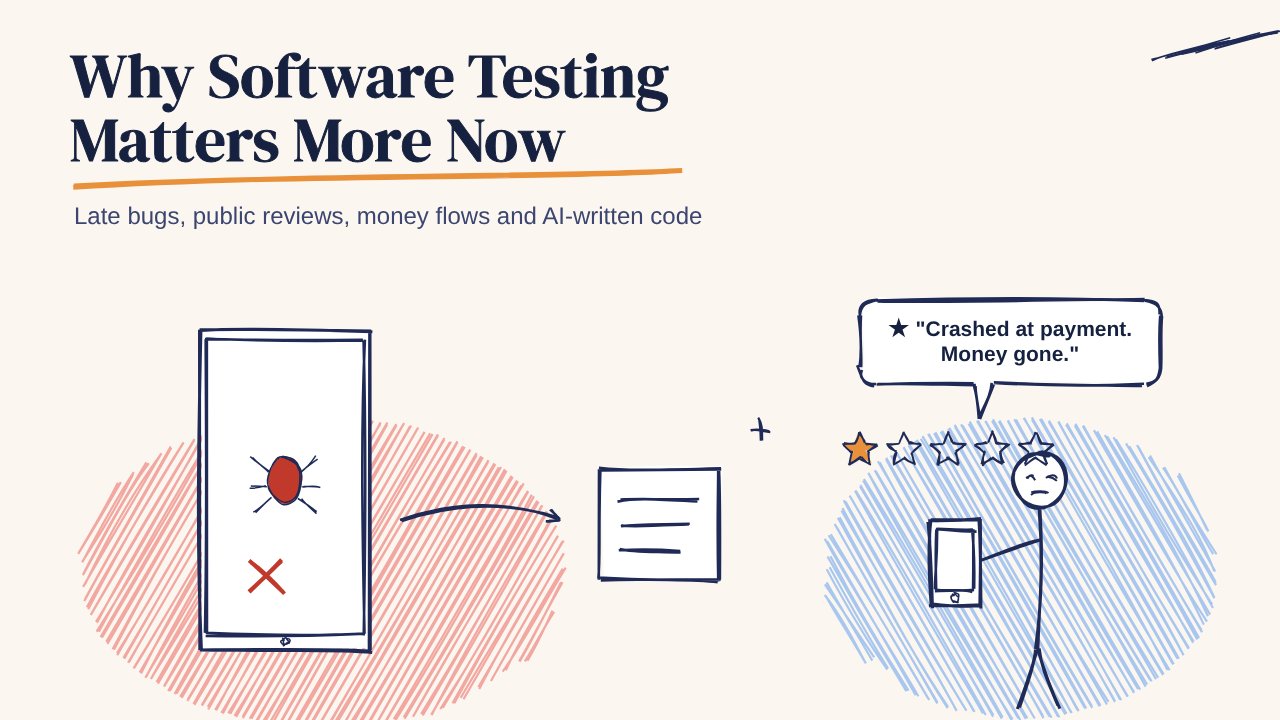
App users don't file bug reports. They leave a one-star review. In the India App Quality Report, about 1 in 9 Play Store reviews of India's top apps described something broken. Those reviews sit on the store page where new users decide whether to install.
3. One showstopper can undo a launch
A crash on the login screen, an OTP that never arrives, or a payment that debits but doesn't confirm can stop a launch on its first day. See what one showstopper bug really costs.
4. Money and personal data are involved
UPI, banking, lending and KYC flows handle money and identity. A bug there isn't just inconvenient. It can mean a duplicate debit, a wrong balance, or an Aadhaar number shown unmasked. Testing these flows carefully is part of keeping users' trust and meeting regulators' expectations.
5. Real-world conditions break "working" code
Code that passes every test on a developer's laptop can still fail on a 3–4 GB RAM Android with the battery saver on, on a weak Jio signal in a lift, or with a dual SIM. Testing on the devices and networks users actually have catches what the lab doesn't.
6. AI writes code faster, so testing matters more
AI coding agents can produce a feature in an afternoon. They can also produce the tests, which often check what the code already does rather than what users need. More code, shipped faster, means more chances for a bug to reach users unless someone checks the result like a real user would.
7. Testing makes releases calmer
Teams with a clear test routine, automated checks on every build and a real-device pass before release, ship more confidently. They spend less time on emergency fixes and more time building.
What good testing looks like for an app team
- Unit and API tests for logic, run on every build
- UI automation for a few stable, critical flows
- Exploratory testing on real phones before each release, focused on login, payments and the newest feature
- A short P1 list that is never skipped
The free 99tests test case library has 950 ready-made cases across 25 Indian app flows to get you started.
Where 99tests fits
99tests runs exploratory testing with real testers on real Android phones and iPhones across Indian cities and networks. You get a reproducible bug report in 3 business days, with packages from ₹9,999 + GST.