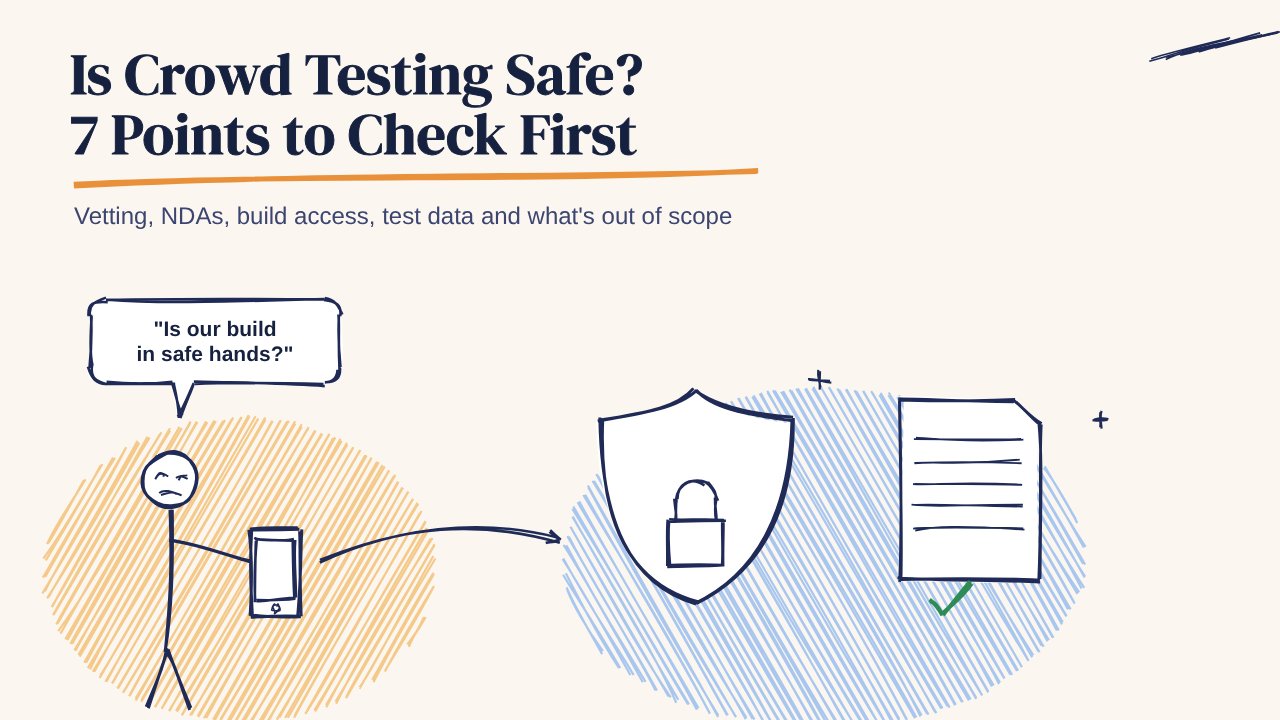
Is Crowd Testing Safe? 7 Points an Enterprise Should Check First
Seven questions an enterprise should ask before using a crowd testing platform: tester vetting, NDAs, build access, test data, report handling, payment trails and what to keep out of scope.
In this article
- 1. Who are the testers, and how are they vetted?
- 2. Is there a confidentiality agreement with each tester?
- 3. How is the build distributed and revoked?
- 4. What data will testers touch?
- 5. Where do bug reports and attachments live?
- 6. How are testers paid, and is there an audit trail?
- 7. What's explicitly out of scope?
- A simple way to lower risk
- How 99tests handles scope
The first worry most enterprises have about crowd testing is simple: "We're giving our unreleased app to strangers." That's a reasonable concern, and the answer depends on how the platform controls who sees what.
Here are seven points to check before you sign up with any crowd testing platform, plus questions to put to the vendor.
1. Who are the testers, and how are they vetted?
Ask how testers join, how identity is checked, and how they get access to paid projects. A platform should be able to say whether every tester on your project has a verified identity and a track record of accepted bugs.
Ask: "Can we limit our project to testers with a minimum history, or to a named shortlist?"
2. Is there a confidentiality agreement with each tester?
Testers should agree to confidentiality terms before they see a client build. Ask to read the tester terms, not just the client contract.
Ask: "What happens to a tester who shares a screenshot publicly?"
3. How is the build distributed and revoked?
Prefer distribution channels you control: Google Play internal or closed testing tracks, TestFlight, or a staging URL behind login. You should be able to remove access the moment the test ends.
Ask: "Can we use our own Play closed track or TestFlight group, and remove testers ourselves?"
4. What data will testers touch?
This is the most important point. Never let testers use production data or real customer accounts. Use a staging environment, sandbox payment keys, and test identities from your KYC provider. For flows like UPI or banking, agree on test accounts with known balances.
Ask: "Do you require a staging environment, and will you refuse to test against production?"
5. Where do bug reports and attachments live?
Screenshots and videos can show sensitive screens. Ask where reports are stored, who at the vendor can see them, and how long they're kept.
Ask: "Can we get the full report and have attachments deleted after the project closes?"
6. How are testers paid, and is there an audit trail?
A platform that pays testers through traceable channels, rather than informally, has a clearer record of who worked on your project and when.
7. What's explicitly out of scope?
A good vendor will tell you what it won't do. Exploratory and functional testing on real devices is a different job from penetration testing, load testing or compliance certification. If you need those, use a specialist, and don't expect a crowd platform to sign off on security.
A simple way to lower risk
Start with a small, low-risk build, such as a staging version with sandbox data, and a short test. Review the report quality and the vendor's handling before you send anything sensitive.
If you're deciding whether crowd testing fits at all, see the top 10 benefits of crowd testing, including where it isn't the right fit.
How 99tests handles scope
99tests runs functional and exploratory testing on real Android phones and iPhones across Indian cities and networks. Automation, security testing, load testing and certification are out of scope. For questions about access, data handling and agreements, write to hello@99tests.com before the test starts.